CAS number: 35354-74-6
Molecular formula: C18H18O2
Molecular weight: 266.33
EINECS number: 609-119-8
Botanical source: Houpoea officinalis (Rehder & E. H. Wilson)
Plant introduction:
Houpoea officinalis (Rehder & E. H. Wilson) N. H. Xia & C. Y. Wu), a deciduous tree of the genus Magnolia of the Magnoliaceae family. The bark is thick, brown, not cracked, oily and spicy; the leaves are large, concentrated on the top of the branches, oblong-ovate, with gray pubescence and white powder below; the flowers are white and fragrant; the fruits are mostly oblong and oval; The seeds are triangular and obovate; the flowering period is from May to June, and the fruiting period is from August to October. Magnolia officinalis is a plant of the genus Magnoliaceae, distributed in Shaanxi, Gansu, Anhui, Zhejiang and other regions. There are about 30 species in my country, of which about 20 species have medicinal value. Magnolia officinalis grows on sunny slopes and forest edges with fertile and deep soil at an altitude of 300-1700m. Magnolia officinalis is a mesophytic tree species that likes light and needs shade in its young stage; it likes a cool, humid, cloudy and relatively high temperature climate. It grows best on slightly acidic or neutral soil with deep, fertile, loose, humus-rich, and well-drained soil. Often grows in mixed deciduous broad-leaved forests, or in evergreen broad-leaved forests. The propagation method of Magnolia officinalis is seed propagation.
Harvesting and storage of raw materials:
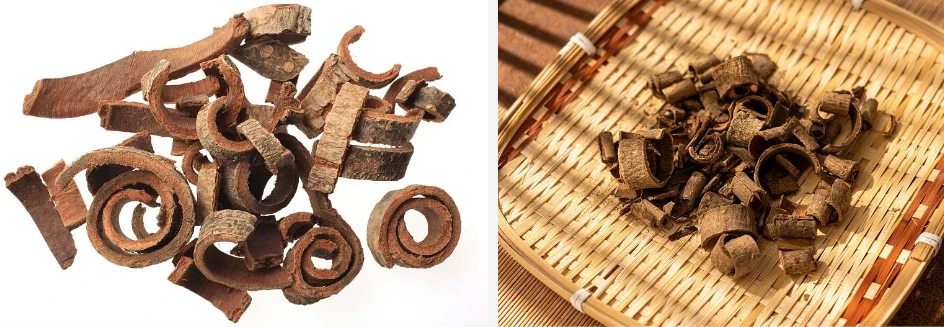
Trees can be cut and peeled after more than 20 years of planting. It should be done during the peak growth period from April to August. The root bark and branch bark are dried directly in the shade or rolled and dried, and are called root bark and branch bark; after the bark can be girded or stripped, the roll is scalded in boiling water until soft, and then buried in a damp place to sweat. When the inner side or cross section of the bark turns purple-brown or tan, and becomes oily or shiny, roll each section of bark into a double tube, tie it tightly with bamboo shoots, cut both ends, and expose to dry.
Honokiol is a pleiotropic compound extracted from the bark or root bark of magnolia plants such as Magnolia grandiflorum and Magnolia alba. Honokiol is an isomer of magnolol. It is a tan to white fine powder. It is a dimer formed by polymerizing the side chain of one phenylpropanoid and the benzene core of another phenylpropanoid. It is called a new Lignans, found mostly in Lauraceae plants, are the active antibacterial and anti-inflammatory components of the traditional Chinese medicine Magnolia officinalis. Honokiol and honokiol are colorless needle-like crystals, easily soluble in benzene, ether, chloroform, ethanol, etc., but difficult to dissolve in water. It reacts with ferric chloride methanol solution to produce blue-black color, reacts with Millon's reagent to produce brown precipitate, and reacts with phloroglucinol hydrochloric acid solution to produce red precipitate.
Honokiol has obvious and long-lasting central muscle relaxation, central nervous system inhibitory effects, anti-inflammatory, antibacterial, anti-pathogenic microorganisms, anti-ulcer, antioxidant, anti-aging, anti-tumor, cholesterol-lowering and other pharmacological effects. It is used for Treat acute enteritis, bacterial or amoebic dysentery, chronic gastritis, etc. Among them, in terms of antibacterial effect, honokiol has significant antibacterial activity against Gram-positive bacteria, acid-resistant bacteria, and filamentous fungi, has a more significant antibacterial effect against Streptococcus mutans, and has the strongest inhibitory effect against Staphylococcus aureus. Clinically, it is mainly used as medicine to eliminate chest and abdominal fullness, sedate the central nervous system, relax muscles in athletes, and is antifungal and antiulcer. In addition, the new uses of honokiol can be extended to mental diseases.
Extraction Method
1. Production process of Magnolia officinalis extract (fluid extract): Grind Magnolia officinalis and soak it with ethanol for 12 hours. Place it in a percolation cylinder and percolate with about 12 times the amount of ethanol. Collect the percolation liquid and recover the ethanol under reduced pressure until it is exhausted. , get the liquid extract. The yield is about 9%, the solid content is 85.0%, it contains more than 11.0% magnolol and more than 5.0% honokiol.
2. Extraction and separation of magnolol and honokiol. Take the coarse powder of magnolia bark dry bark, add 1/5 amount (W/W) of quicklime powder, mix well, and infiltrate with 15-20 times the amount of distilled water. Add hydrochloric acid to the percolate Chemicalbook to adjust the pH to 2 to 3 and let it stand. Collect the precipitated precipitate, wash it with distilled water until the pH value of the precipitate is 6 to 7, dry it, add alumina (1:10), mix evenly, place it in an extractor, and extract with cyclohexane. Concentrate the cyclohexane extract and let it cool, white crystals will precipitate, and the crystals and mother liquor will be obtained by filtration. Crystallization is recrystallized with cyclohexane, which is honokiol. After the mother liquor is concentrated, crystals precipitate, and cyclohexane is recrystallized to obtain colorless flaky crystals, which are magnolol crystals. The yield of magnolol is 85%, and the yield of honokiol is 74%.
Application fields: food, health products, medicines
Application forms: suppositories, lotions, tablets, capsules, etc.
Store in a cool:dry place away from light and high temperatures. Storage temperature: 2-8°C.
If you would like to learn more, please contact sales@sxytbio.com,Click here to contact us online