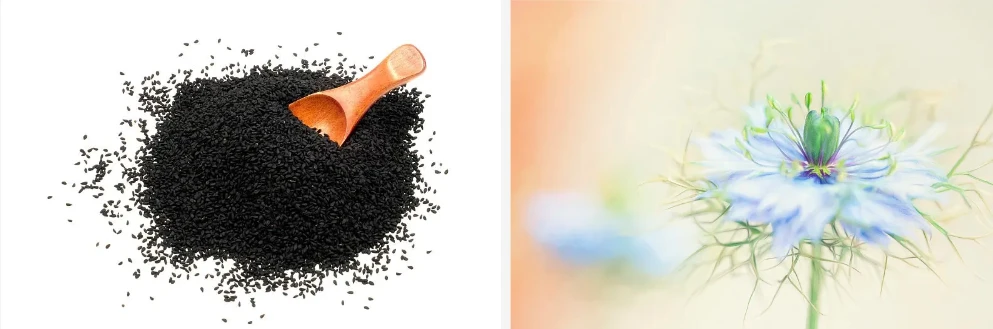
Thymoquinone is a phytochemical that occurs naturally in black seed, as well as in the Monarda fistulosa plant, which is cultivated in the United States and can be distilled to obtain the essential oil.
Thymoquinone is the main component of black grass seed extract. Black grass seed contains damascenine and volatile oil. The oil mainly contains thymoquinone, niqullon, quercetin, saponin and so on.
In laboratory animals and cell experiments, thymoquinone has been shown to have powerful anti-inflammatory and antioxidant effects. It is also used in the study of various cardiovascular and cerebrovascular diseases, diabetes, neurological diseases, stroke and cancer. A 2016 study found that thymoquinone also has anti-addiction properties.
In the NCBI(National Center for Biotechnology Information) paper, through various experiments, it has been proved that black seed has the following effects, mainly by the positive role of substances such as thymoquinone.
Nigella sativa extract
effect
1. Antioxidant effect
The antioxidant activity of the volatile oil of Black seed grass was determined by thin layer chromatography. It was found that thymoquinone and its components vacrol, T-anisol and 4-terpinol had antioxidant activity. In the experiments of nonenzymatic lipid peroxidation and deoxyribose degradation of liposome, OH free radicals were effectively removed. The essential oil of black seed grass can significantly improve the antioxidant indexes of glutathione -s transferase, glutathione reductase and glutathione peroxidase (GSH-Px) in response to potassium bromate induced oxidative stress. Similarly, in rats fed with atherogenic suspension, it has been reported that methanol extract and volatile oil from black seed oil can supplement the total antioxidant capacity of plasma against free radicals by an average of 88%.
2, antibacterial effect
Black seed extract has effective antibacterial activity against Gram-positive bacteria (Staphylococcus aureus) and Gram-negative bacteria (Pseudomonas aeruginosa and Escherichia coli). The extract has synergistic effect with streptomycin and gentamicin, and also has addictive effect with Daguanomycin, erythromycin, tobramycin, doxycycline, chloramphenicol, nalidixic acid, ampicillin, Lincomycin, sulfamethoxazole - trimethoprim. These results indicate that the extract has antibacterial effect. A mouse cytomegalovirus model was used to study the complete inhibition of viral titers in liver and spleen on day 3 after viral infection and was consistent with elevated serum levels of gamma-interferon (IFN-γ), macrophages, and CD4+T cells. On day 10 of infection, no viral titers were detected in the liver and spleen of mice treated with black seed oil. The results showed that black seed grass had significant antiviral activity against mouse cytomegalovirus by increasing the production of macrophages and IFN-γ.
3. Anti-diabetic effect
In streptozotocin (STZ) -induced diabetic rats, black seed extract and thymoquinone significantly reduced blood glucose levels and increased insulin levels. Treatment with black seed grass and thymoquinone significantly increased the area of insulin-immune reactive beta cells. In diabetic animals, the ultrastructural characteristics of axons also showed significant improvements, suggesting that black seed and thymoquinone have a potential therapeutic effect on STZ-induced peripheral neuropathy in diabetic rats. Black seed grass and its component thymoquinone have the greatest anti-diabetic potential in liver gluconeogenesis, absorption of glucose in the intestine, blood glucose level, and simulation of glucose-induced insulin secretion of islet cells. The effect of improving glucose tolerance is comparable to that of metformin. No obvious adverse reactions have been shown so far, and the toxicity is very low.
4, anti-cancer effect
The antitumor activity of black seed oil and petroleum ether extracts against human lung cancer cell lines was studied. Black seed oil (0.10, 0.25, 0.50, 1.00 mg/mL) and black seed extract (0.25, 0.50, 1.00 mg/mL) were added to cells for 24h. Black seed extract and black seed oil significantly reduced cell viability and altered A-549 cell morphology in a concentration-dependent manner. In another study, the anti-proliferative activity and thymoquinone content of mouse colon cancer cells were measured in vitro by black seed extract obtained by heat treatment of different seeds. Under the different heat treatment conditions of 25℃, 50℃, 100℃ and 150℃, the oil produced by heating seeds at 50℃, 100℃ and 150℃ had strong inhibition of tumor cell growth and higher thymoquinone content, and inhibited NF-κB signaling pathway. Studies have shown that thymoquinone expresses p21 through p53-independent pathway in human colon cancer cells, and cell cycle arrest induces apoptosis in S phase. Thymoquinone treatment of DLD-1(human colon cancer cell line) increased the phosphorylation of mitogen-activated protein kinase extracellular signal-regulated kinase and c-Jun N-terminal kinase, but did not significantly change the phosphorylation of p38. This provides evidence for a link between the pro-oxidation effects of thymoquinone and its apoptotic role in colon cancer, and shows a protective effect of mitogen-activated protein kinase.
5, anti-inflammatory effect
Both black seed oil and thymoquinone inhibit the production of arachidonic acid in leukocytes through the cycoperoxidase and 5-LO pathways that inhibit arachidonic acid metabolism. This suggests that black seed oil and thymoquinone can be used in the treatment of rheumatism and related inflammatory diseases. In a comparative study, an ethanol extract of black seed grass and an extract of diclofenac sodium, an anti-inflammatory drug, significantly reduced foot inflammation in albino rats. The ethanol extract of black seed grass has a strong anti-inflammatory effect on albino rats, however, this effect produces a slightly smaller effect than diclofenac sodium, but lasts longer.
Thymoquinone is a chemical with the formula C10H12O2
Check method of Bailixing:
Hundred with impurities
Not more than 5%
Hundred li wake water
No more than 10.0%
100 li with total ash
No more than 8.0%
A hundred miles makes a lot of things
Determination by thermal diffusion method under the method of determination of alcohol soluble effluents, with alcohol as solvent, shall not be less than 25.0%
Determination of thyme content
Measured by high performance liquid chromatography
The chromatographic conditions and system suitability tests used octadecylsilane bonded silica gel as filler. Methanol, water, ice acid, triethylamine 87:13:0:0:02) was used as the mobile phase, and the detection wavelength was 210nm. The number of theoretical plates calculated according to the first element peak of ivy soap should not be less than 3000.
If you would like to learn more, please contact sales@sxytbio.com,Click here to contact us online