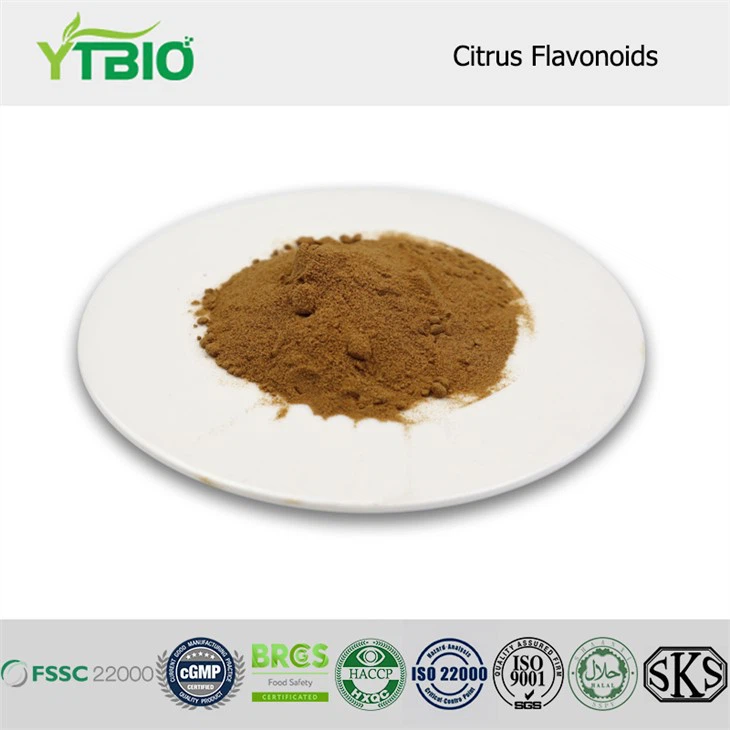
Shaanxi Yuantai Biological Technology Co., Ltd. is one of the most reliable manufacturers and suppliers of citrus flavonoids in China. With abundant experience, we warmly welcome you to wholesale bulk citrus flavonoids for sale here from our factory. Quality products and reasonable price are available.
What is Citrus flavonoids?
Citrus flavonoids are mainly found in the outer skin of citrus fruits (including the outer peel and capsule). Citrus has been used as a traditional Chinese medicine for thousands of years in China. The research on the biological activity and anti-cancer activity of citrus flavonoids has been increasingly in-depth. Citrus flavonoids can be roughly divided into categories according to the flavonoid structure: flavonoid glycosides, such as naringenin, hesperidin, etc.; polymethoxyflavonoids, such as citrus tangerin. Among them, hesperidin is used as an auxiliary drug to improve vascular diseases in patients; hesperidin has anti-inflammatory and analgesic effects, and when used in combination with diomin, the results of in vivo and in vitro studies have shown significant protective effects; when used in combination with naringin, it has the effect of lowering cholesterol and anti-cancer; clinical studies have also shown that it can alleviate women's menopause.
Pharmacological effects
1. Antioxidant effect of citrus flavonoids
1) Antioxidant effect in vitro
The scavenging effect of flavonoids on reactive oxygen species is one of the hot topics currently attracting much attention. The flavonoids and isoflavones contained in citrus have significant antioxidant activity. Polymethoxyflavonoids are the flavonoids with the strongest antioxidant activity found in citrus in recent years. Through research, it was found that citrus flavonoids have a significant effect in scavenging reactive oxygen free radicals in vitro, and their inhibitory effect on the autoxidation rate of pyrogallol is particularly significant.
Through research, it was found that although there are significant differences in the reducing ability of citrus peel flavonoids and the scavenging effect on DPPH free radicals from 9 different varieties, they all have antioxidant and free radical scavenging effects. The flavonoids extract from citrus peel has a certain scavenging effect on hydroxyl radicals (·OH) and superoxide anions (O2-·). The above studies show that citrus flavonoids have strong antioxidant and free radical scavenging effects in the body, and can be used as natural antioxidants in food, health products, medicines, and cosmetics, and have good application prospects.
2) Antioxidant effect on cardiovascular system
In recent years, with the research on cardiovascular and cerebrovascular diseases, flavonoids have gradually become a hot spot in the research and development of natural drugs and functional foods. The World Health Organization proposed in the report "Diet, Nutrition and the Prevention of Chronic Diseases" that citrus fruits can effectively prevent the occurrence of cardiovascular diseases. At present, research on the effects of citrus flavonoids on the cardiovascular system mainly focuses on cardiotonic and lipid-lowering aspects.
3) Antioxidant effect on nervous system and immune system
A large amount of literature shows that the citrus flavonoid nobiletin is an effective compound in the treatment of neurodegenerative diseases. It has neurotrophic activity and can inhibit the neurotoxic damage of β-amyloid protein (Aβ) to neurons and reduce the damage of H2O2 to nerve cells. Oxidative damage, improve learning and memory impairment induced by cerebral ischemia, etc.
Citrus flavonoids can protect oxidative stress by increasing the stability of the cell membrane system, enhancing cellular antioxidant activity, reducing the content of reaction products between intracellular reactive oxygen species and lipid peroxides, and reducing the activity of apoptotic protease Caspase-3. The purpose of stimulating cells is to prevent and treat neurodegenerative diseases such as AD (Alzheimer's disease) and PD (Parkinson's disease). Hesperidin and nobiletin in citrus flavonoids both have an activating effect on NMU2R, and have high efficacy within a certain concentration range. Citrus flavonoids are expected to be developed into safer and more efficient drugs for neurological diseases due to their multiple effects on nerve cells and nervous system.
4) Hypoglycemic effect
According to the latest data released by the World Health Organization, diabetes has become the third largest disease after cardiovascular and cerebrovascular diseases and malignant tumors. Diabetic patients require long-term medication, and Western medicines for hypoglycemic drugs have serious side effects. Therefore, the search for active ingredients with hypoglycemic effects from natural resources has attracted increasing attention. At present, research on the hypoglycemic effect of flavonoids has become a hot topic at home and abroad. Through research, it has been found that citrus flavonoids play an important role in preventing hyperglycemia. They regulate blood sugar in part by enhancing starch resistance by combining with starch, promoting glycogen synthesis by increasing glycolysis, and reducing gluconeogenesis. Promote the utilization of glucose by liver cells.
5) Antibacterial, antiviral and anti-inflammatory activities
The significant antibacterial, antiviral and anti-inflammatory activities of citrus flavonoids have been confirmed with the continuous reports of research results. The study found that five flavonoids in the ethanol extract of citrus peel have good antibacterial effects on the pathogenic bacteria of tea moire leaf blight. Through research on the in vitro antibacterial activity of citrus flavonoids, it was found that citrus flavonoids have the strongest effect on Staphylococcus aureus and Bacillus subtilis, followed by Escherichia coli, Pseudomonas aeruginosa and Salmonella Paratyphi B. Citrus peel total flavonoids can also antagonize the progression of adjuvant arthritis in rats.
2. Anti-tumor activity
Citrus flavonoids have anti-cancer activity, and their significant anti-cancer effects have been confirmed by continuous reports of research results, mainly involving liver cancer, lung cancer, breast cancer, colon cancer, pancreatic cancer, gastric cancer, etc. Studying the anti-proliferative activity of citrus flavonoids on four types of tumor cells, it was found that citrus flavonoids have a good inhibitory effect on ovarian cancer and breast cancer cells. Through research, it was found that the citrus flavonoid nobiretin can effectively inhibit the in vivo growth of chronic myelogenous leukemia cells K562. growth and proliferation in vitro, and can inhibit angiogenesis of tumor tissue.
Function
In vitro tests have shown that different citrus flavonoids have good specific inhibitory effects on different cancer cells. For example: Nobiletin has good inhibitory effects on Hela cells, THP-1 cells, Colon26 cells, and S180 cells; Hesperidin has obvious inhibitory effects on THP-1 cells, P388 cells, and SNIU-668 cells; Isorhamnetin has good inhibitory effects on BEL-740, Bcap37, SW1990, KB-3-1 cells. In vivo tests have shown that Nobiletin can inhibit the metastasis of mouse colon cancer, inhibit the growth of S180 cells, inhibit the growth and metastasis of Lewis, and inhibit the growth of mouse melanoma B16; The combined use of Nobiletin and Citrus citrus has a high inhibition rate on mouse WEHI3B (JCS) cells; Hesperidin has the effect of inhibiting the carcinogenic effect of carcinogens that induce lung cancer. The research on the mechanism of anticancer effect of citrus flavonoids is gradually deepening. At present, the main technologies used are Hoechst fluorescence detection of chromosome aggregation and apoptotic body generation, flow cytometry detection of cell apoptosis, gel electrophoresis detection of DNA breakage, Western blot detection of apoptosis regulatory proteins Bcl-2 and BAX, and detection of Caspase-3 activity. These methods provide scientific basis for studying its mechanism of action. For example, naringin can activate Caspase-3 activity, inhibit P-glycoprotein expression, and increase cell sensitivity to drugs; nobiletin directly inhibits MEK activity, thereby inhibiting ERK phosphorylation and MMP expression, achieving anticancer effects; nobiletin inhibits NF-κB activity, preventing it from binding to DNA, thereby inhibiting the production of RCS products.
Company Introduction And Certificates Obtained
YTBIO mainly supplies Citrus Flavonoids etc. The company was established in 2014 and has many years of R&D and production experience. We are committed to the research and development, production and sales of raw materials for the 21st century health industry. The certificates obtained so far include ISO9001, ISO22000, HALAL, KOSHER, HACCP, FDA,etc. We always maintain the highest requirements for product quality.

Our Packaging

Our Team

Factory

Payment&Shipping

Hot Tags: citrus flavonoids, China citrus flavonoids manufacturers, suppliers, factory