Shaanxi Yuantai Biological Technology Co., Ltd. is one of the most reliable manufacturers and suppliers of l-tyrosine powder in China. With abundant experience, we warmly welcome you to wholesale bulk l-tyrosine powder for sale here from our factory. Quality products and reasonable price are available.
What is L-tyrosine powder?
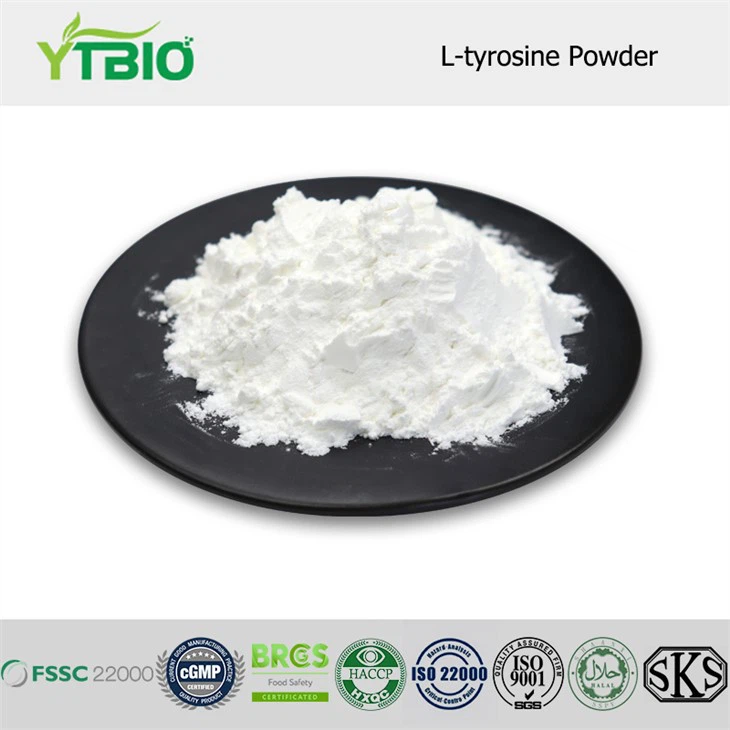
L-tyrosine Powder is a white crystalline powder, which crystallizes from water into needles or flakes. Relative density is 1.456 (20℃), isoelectric point is 5.66, it has the ability to absorb ultraviolet rays, has the maximum light absorption at a wavelength of 274nm, and can reduce phosphomolybdic acid-phosphotungstic acid reagent (Folin reagent). Melting point: the left-handed body decomposes at 290-295℃ (slow heating), decomposes at 314-318℃ (rapid heating), the racemic body decomposes at 290-295℃ (slow heating), and decomposes at 340℃ (rapid heating). Soluble in water, ethanol, acid and alkali, insoluble in ether. The aqueous solution of the right-handed body reacts with tyrosinase to show red. The left-handed isomer can generate light by friction. When heated with a barium hydroxide aqueous solution at 170°C, it turns into a racemic isomer. The ortho position of the phenolic hydroxyl group in the tyrosine molecule is prone to chemical reaction. It is coupled with diazobenzenesulfonic acid to obtain an orange-red substance. It reacts with boiling dilute acetic acid and sodium nitrite to show purple or red, reacts with warm nitric acid to show yellow, and reacts with titanium dioxide in sulfuric acid to show dark orange-yellow. Natural tyrosine is a left-handed isomer and can be obtained by protein hydrolysis and refining. Tyrosine is a non-essential amino acid and a raw material for a variety of products in the body. Tyrosine can be converted into a variety of physiological substances in the body through different metabolic pathways, such as dopamine, adrenaline, thyroxine, melanin, and papaverine from poppy (opium). These substances are closely related to nerve conduction and metabolic regulation and control. Studying tyrosine metabolism helps to understand the pathological process of certain diseases. For example, alkaptonuria is related to tyrosine metabolism disorder. The patient lacks tyrosine oxidase, which causes the tyrosine metabolite 3,4-dihydroxyphenylalanine to be unable to continue to decompose. It is excreted in the urine and oxidized into a black substance when exposed to air. The diapers of children with this disease will gradually turn black when exposed to air, and this urine will also turn black if left for a long time. Albinism is also related to tyrosine metabolism. The patient lacks tyrosinase, which causes the tyrosine metabolite 3,4-dihydroxyphenylalanine to be unable to form melanin, resulting in white hair and skin.
Tyrosine and its metabolism
Tyrosine is an amino acid that constitutes proteins. It has an ionized aromatic ring side chain and is hydrophilic. Tyrosine is produced by the hydroxylation of phenylalanine in humans and animals, so when phenylalanine is sufficient, it is a non-essential amino acid. The catabolism of tyrosine is first converted into p-hydroxyphenylpyruvate under the catalysis of tyrosine aminotransferase in the liver. This enzyme requires pyridoxal phosphate as a coenzyme. p-hydroxyphenylpyruvate is acted upon by p-hydroxyphenylpyruvate hydroxylase, which simultaneously causes the oxidative decarboxylation and transfer of side chain pyruvate and the hydroxylation of the ortho position of the benzene ring to produce homogentisate (dihydroxyphenylacetic acid). This enzyme is a copper-containing metalloprotein that requires ascorbic acid as a coenzyme and consumes molecular oxygen. Homogentisate splits the benzene ring under the catalysis of homogentisate dioxygenase (homogeneous acid oxidase) to produce maleic acetoacetate; this enzyme is an iron-containing metalloprotein and requires one molecule of oxygen to participate in the reaction. Maleyl acetoacetate is converted into fumarylacetoacetate by the action of the corresponding isomerase, which requires glutathione as a coenzyme. Finally, it is hydrolyzed into fumaric acid and acetoacetate by the corresponding hydrolase, so tyrosine is both a glucogenic and a ketogenic amino acid.
Applications
1. Amino acid drugs. Raw materials for amino acid infusion and amino acid compound preparations, as nutritional supplements. Used to treat poliomyelitis and tuberculous encephalitis/hyperthyroidism.
2. Nutritional supplements. Used in medicine to treat myelitis, tuberculous encephalitis, hyperthyroidism, etc., and also used to make L-dopa diiodotyrosine. After heating with sugars to produce aminocarbonyl reaction, special aromatic substances can be generated.
3. Used in biochemical research, used as amino acid nutritional drugs in medicine to treat poliomyelitis, encephalitis, hyperthyroidism and other diseases.
4. Biochemical reagents, APIs. It is a non-essential amino acid for the human body.
5. Can be used for tissue culture (L-tyrosine·2Na·H2O), biochemical reagents, and treatment of hyperthyroidism. It can also be used to prepare food for the elderly, children and plant leaf nutrients.
Company Introduction And Certificates Obtained
YTBIO mainly supplies L-tyrosine Powder etc. The company was established in 2014 and has many years of R&D and production experience. We are committed to the research and development, production and sales of raw materials for the 21st century health industry. The certificates obtained so far include ISO9001, ISO22000, HALAL, KOSHER, HACCP, FDA,etc. We always maintain the highest requirements for product quality.

Our Packaging

Our Team

Factory

Payment&Shipping

Hot Tags: l-tyrosine powder, China l-tyrosine powder manufacturers, suppliers, factory