
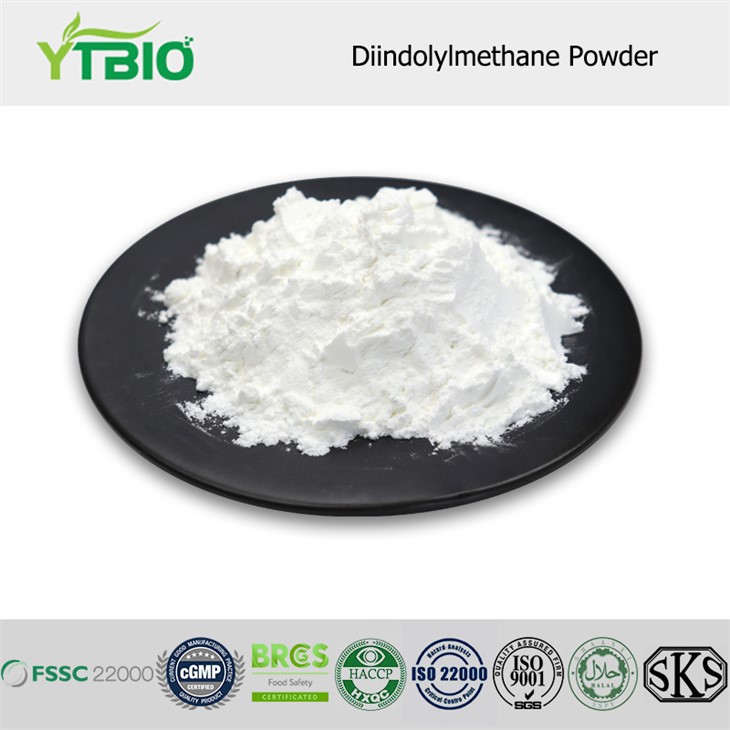
Shaanxi Yuantai Biological Technology Co., Ltd. is one of the most reliable manufacturers and suppliers of diindolylmethane powder in China. With abundant experience, we warmly welcome you to wholesale bulk diindolylmethane powder for sale here from our factory. Quality products and reasonable price are available.
What is Diindolylmethane powder?
Studies have shown that indole can regulate bacterial behaviors such as biofilm formation, motility, virulence, and antibiotic resistance. More importantly, many indole derivatives (7-hydroxyindole, indole-3-acetaldehyde, and 3-indoleacetonitrile) even show stronger biofilm inhibition activity. 3,3'-Diindolylmethane (DIM) is an indole derivative found in Brassica vegetables of the cruciferous family. Previous studies have shown that DIM has multiple biological activities, but the effects of DIM on bacterial biofilm formation, extracellular matrix, and its potential application prospects in the food industry are still unclear.
In vitro studies
DIM is an effective radiation protector and mitigator, acting by stimulating ATM-driven DDR-like responses and NF-κB survival signals. DIM can inhibit tumor cell invasion, angiogenesis, proliferation and induce apoptosis by regulating signaling pathways such as AKT, NF-κB and FOXO3. It can also inhibit estrogen-induced gene expression and cause endoplasmic reticulum stress. ChemicalbookDIM can alter estrogen metabolism and antagonize estrogen and androgen receptor activity.
In vivo studies
After multiple administrations of DIM, it can effectively protect against whole-body radiation. In vivo experiments, DIM has a radiation protective or mitigating effect. In normal tissues, DIM activates ATM. DIM can be administered to mice by oral gavage (250mg/kg) with high bioavailability and no acute toxicity.
Research data
Effect of 3,3'-diindolylmethane (DIM) on S. aureus biofilm
The effect of DIM on S. aureus biofilm formation and bacterial growth is shown in Figure 1. When DIM was at 31.2 μmol/L and 62.5 μmol/L, its biofilm inhibitory activities were 50% and 90% respectively, which were higher than those currently reported. Biofilm inhibitory activity of most small molecule compounds. When the concentration was higher than 62.5 μmol/L, the biofilm inhibitory effect was not significantly enhanced (P>0.05). Therefore, the minimum biofilm inhibitory concentration (MBIC) of DIM for S. aureus is 62.5 μmol/L.

Figure 1 Effect of DIM on S. aureus biofilm
Effect of 3,3'-diindolylmethane (DIM) on the growth of S. aureus bacteria
The impact on bacterial growth and biofilm structure are two important indicators for evaluating the effectiveness of biofilm inhibitors. Promising biofilm inhibitors should have little or no impact on bacterial growth on the premise of inhibiting biofilm. The effect of DIM on bacterial growth is shown in Figure 2. There was no significant difference in cell density between the blank control group and the treatment group (Figure 2A). And when the DIM concentration ranges from 31.2 μmol/L to 62.5 μmol/L, the bacterial metabolic activity involved in biofilm formation (the absorbance value at 490 nm of the water-soluble orange-yellow formazan product reduced by living cells) is dose-dependent. The metabolic activity of planktonic cells increased in a dose-dependent manner, but there was no significant difference in the sum of metabolic activities between the control group and the treatment group (P>0.05) (Figure 2B), confirming that DIM at the test concentration has an effect on S. aureus has no antibacterial activity, that is, the biofilm inhibitory activity of DIM on S. aureus is not achieved by inhibiting growth.

Figure 2 Effect of DIM on the growth of S. aureus
This article studied the biofilm inhibitory activity of 3,3'-diindolylmethane (DIM) against S. aureus for the first time. The results show that DIM can be used to inhibit the formation of S. aureus biofilm on common food contact surfaces. DIM has almost no effect on bacterial growth at efficient biofilm inhibitory concentrations, and has the potential to be developed into a new biofilm inhibitor to prevent S. aureus and other common foodborne pathogenic bacteria form biofilms on food contact surfaces to ensure food safety.
Disclaimer
Company Introduction And Certificates Obtained
YTBIO mainly supplies Diindolylmethane Powder etc. The company was established in 2014 and has many years of R&D and production experience. We are committed to the research and development, production and sales of raw materials for the 21st century health industry. The certificates obtained so far include ISO9001, ISO22000, HALAL, KOSHER, HACCP, FDA,etc. We always maintain the highest requirements for product quality.

Our Packaging

Our Team

Factory

Payment&Shipping

Hot Tags: diindolylmethane powder, China diindolylmethane powder manufacturers, suppliers, factory