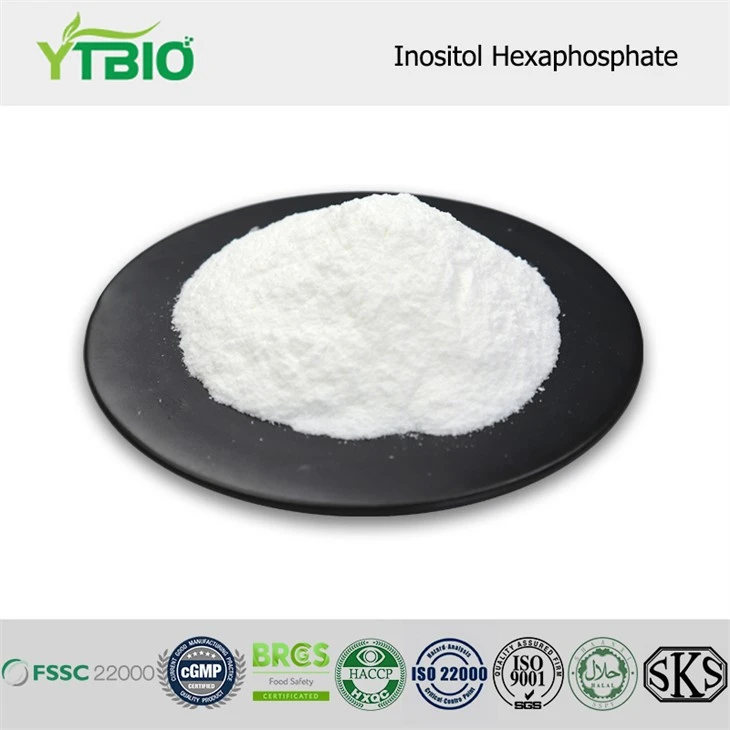
Shaanxi Yuantai Biological Technology Co., Ltd. is one of the most reliable manufacturers and suppliers of inositol hexaphosphate in China. With abundant experience, we warmly welcome you to wholesale bulk inositol hexaphosphate for sale here from our factory. Quality products and reasonable price are available.
What is IP6?
 Inositol hexaphosphate, abbreviated as IP6, is also known as phytic acid. It is a natural compound composed of inositol and six phosphate ions, widely found in natural foods such as rice, oats, corn, wheat, and green beans. Due to its unique chemical properties and physiological functions, it has a wide range of applications in food, medicine, polymer industry, and daily chemical products.
YTBIO supplies inositol hexaphosphate with a purity of ≥99%. All our production processes strictly adhere to international certification systems such as cGMP, FSSC22000, BRC, HALAL, KOSHER, ISO9001, and ISO22000. With over ten years of experience in the production of plant extracts and functional raw materials, and a Class 100,000 cGMP cleanroom, we provide you with high-purity inositol hexaphosphate raw materials.
Mechanism of Action
Gene protection: Prevent cancer by reducing DNA damage and enhancing the activity of tumor suppressor genes (such as p53); the important role of IP6 (inositol hexaphosphate) in DNA repair is mainly reflected in its participation in the non-homologous end joining (NHEJ) process. As a cofactor, IP6 helps repair DNA double-strand breaks (DSBs) in this process, thereby maintaining the stability of the genome.
IP6 helps repair DNA double-strand breaks by participating in the non-homologous end joining process. In this process, IP6 interacts with proteins related to DNA repair to promote the connection and repair of DNA ends. Specifically, IP6 kinases (IP6Ks) play a key role in DNA repair. They participate in a variety of cellular processes, including DNA repair, chromosome recombination, cell death, etc., by adding phosphate groups to the inositol ring.
Enhance immunity: Improve the toxicity of natural killer cells (NK cells) and enhance the body's ability to eliminate cancer cells.
Antioxidant effect: inhibits iron-mediated oxidative stress and protects cells from free radicals.
(Normal function of iron ions: Iron (Fe²⁺/Fe³⁺) is an essential trace element for the human body and is involved in key physiological processes such as hemoglobin synthesis and energy metabolism. Iron-mediated oxidative stress: When iron ions are excessive or in a free state, they will catalyze the generation of reactive oxygen species (ROS) through the Fenton Reaction:
Fe2++H2O2→Fe3++⋅OH+OH−Fe2++H2O2→Fe3++⋅OH+OH−
The generated hydroxyl radicals (·OH) are strong oxidants that can damage cell membranes, proteins, DNA and other structures.)
Hazards of free radicals: Free radicals (such as ·OH, superoxide anions, etc.) will attack cell components, leading to:
- Lipid peroxidation (cell membrane damage)
- Protein denaturation (enzyme inactivation)
- DNA breakage (mutation or cell death)
Oxidative stress: When free radical generation exceeds the cell's ability to clear it, it can lead to cellular dysfunction and is associated with diseases such as aging, inflammation, and neurodegenerative diseases (such as Alzheimer's disease).
Strategy: Block the harmful effects of iron ions by:
- Iron chelators: Bind free iron to prevent it from participating in the Fenton reaction.
- Antioxidants: Directly remove generated free radicals.
- Regulate iron metabolism: Reduce the concentration of free iron in cells.
IP6 chelates free iron ions and inhibits the generation of free radicals (such as hydroxyl radicals) catalyzed by them, thereby reducing oxidative stress damage to cell membranes, proteins, and DNA. This mechanism helps prevent cardiovascular disease and chronic inflammation.
IP6 reduces inflammatory responses and organ fibrosis (such as liver fibrosis) by inhibiting pro-inflammatory factors (such as TNF-α) and collagen deposition.
Other health benefits
- Cardiovascular health: Reduces serum cholesterol and triglyceride levels, inhibits low-density lipoprotein (LDL) oxidation, and prevents the formation of atherosclerotic plaques. At the same time, it protects the survival rate of myocardial cells in ischemia-reperfusion injury.
- Kidney protection: IP6 binds to calcium ions in urine, reduces the formation of calcium oxalate crystals, and effectively prevents kidney stones.
- Anti-inflammatory and anti-fibrosis: Relieves chronic inflammation and tissue fibrosis.
- Blood sugar control: In animal experiments, blood sugar in the intervention group decreased by 20%.
- Antiviral: IP6 binds to HIV virus capsid protein, blocking the virus from entering host cells.
- Nervous system protection: Clears beta-amyloid protein and slows down cognitive decline caused by Alzheimer's disease
Special findings
IP6 has shown special effects in increasing bone density, which is a major effect that Professor Samsudin has not discovered. In many of the actual cases we have tried, bone density can increase significantly within one to three months, returning from below average to normal values
Synergistic effect of IP6 and inositol
The combination of inositol (precursor of IP6) and IP6 can significantly increase the concentration of active molecules such as IP3, which is responsible for transmitting growth factor signals and regulating calcium ion release.
Safety and recommended dose
- IP6 has been proven to be highly safe, with no obvious toxic side effects, and is suitable for long-term use. According to the toxicity LD50 experimental data, the toxicity of IP6 (4.2g/kg) is lower than the 3g/kg of salt.
- The recommended dose needs to be combined with the individual's health status, but in experiments, 1-4 grams per day is usually the effective range. However, we found that in actual cases, patients usually need to take no less than 20g/day of IP6 to achieve a significant increase in bone density. It should be noted that it is best to separate it from mealtime by at least 1 hour, and about 5% of people may experience mild diarrhea in the early stage of taking it.
Inositol Hexaphosphate: Does it have skincare benefits?
The whitening mechanism of IP6 is related to its structure. The cyclic molecule contains six phosphate groups, resulting in a strong negative charge upon dissociation. On one hand, phytic acid inhibits tyrosinase activity by chelating copper ions required by tyrosinase, reducing melanin production and deposition, thus achieving a whitening effect. On the other hand, phytic acid is acidic and can gently exfoliate the stratum corneum, accelerating the shedding of existing melanin and aged stratum corneum, which is beneficial for whitening and skin rejuvenation. Most oxidation processes produce highly reactive free radicals. Phytic acid can inhibit lipid peroxidation by chelating metal ions in enzymes during free radical metabolism. Therefore, it can synergistically enhance the effects of antioxidants and can also be used in anti-aging, sun protection, anti-inflammatory, and repair products.
Inositol Hexaphosphate: Applications Overview
Food Industry: Used for preservation, anti-oxidation, metal chelation, and color protection.
Pharmaceutical Industry: Has potential value in kidney stone prevention, cardiovascular protection, and the prevention of diabetic complications.
daily Chemical Industry: Commonly added to skincare products and shampoos for whitening, moisturizing, and improving scalp health.
Chemical and Industrial Industries: Used as a metal corrosion inhibitor, plastics additive, and textile treatment agent.
Agriculture and Feed: Used to regulate plant growth and improve phosphorus utilization in feed, reducing the environmental impact of animal husbandry.

Contact us
Start Your Project with YTBIO Inositol Hexaphosphate 99%
Telephone/WhatsApp:+8617782577059
Email:sales@sxytbio.com
Hot Tags: inositol hexaphosphate, China inositol hexaphosphate manufacturers, suppliers, factory