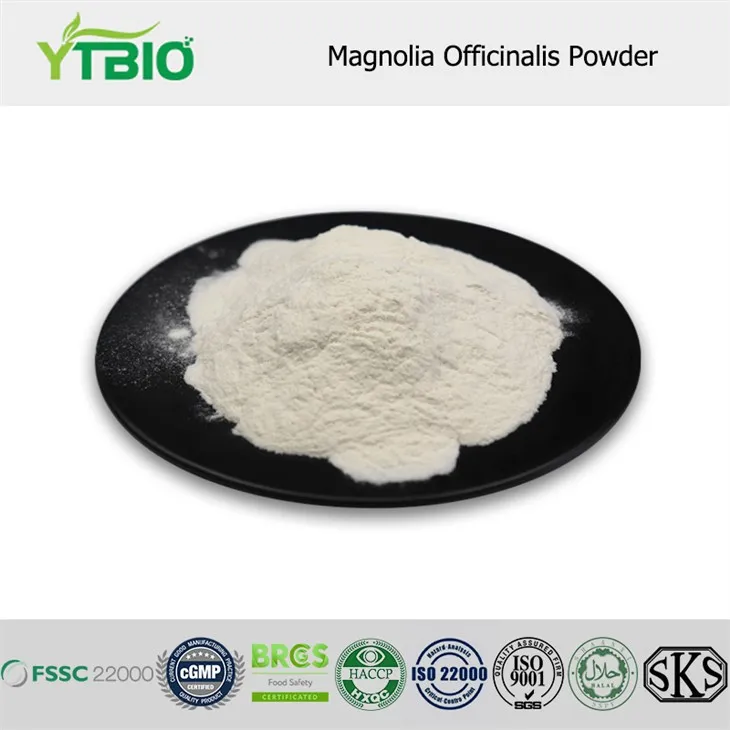
What is Magnolia Officinalis Powder?
Magnolia Officinalis Powder total phenol is an active substance extracted from the dried bark, branch bark and root bark of Magnolia officinalis and Magnolia Officinalis Powder of the Magnoliaceae family. It has antibacterial, anti-inflammatory, anti-tumor, anti-endomycin, muscle relaxant, and acute inflammatory pain relief effects.
Magnolia Officinalis Powder is a white powder crystal. It is soluble in benzene, ether, chloroform, and acetone, insoluble in water, and easily soluble in dilute alkaline solution to obtain sodium salt. Phenolic hydroxyl groups are easily oxidized, while allyl groups are easily subjected to addition reactions. It has a special and lasting muscle relaxant effect and a strong antibacterial effect, and can inhibit platelet aggregation. It is mainly used as an antibacterial and antifungal drug in clinical practice.
Active ingredients: Honokiol, magnolol, and magnolol.
Plant source: The active ingredient with antibacterial effect in the Chinese medicine Magnolia officinalis bark.
What is the function?
1. Muscle relaxation effect
The aqueous extract of Magnolia officinalis has a significant curare-like effect. Its alcohol extract can reduce grip strength and has a strong inhibitory effect on spasms induced by strychnine, picrotoxin and other drugs. It can relieve intestinal spasm caused by barium chloride and pilocarpine, and inhibit the contraction of isolated guinea pig bronchial smooth muscle caused by histamine. A water-soluble alkaloid isolated from Magnolia officinalis - Magnolia officinalis (also known as magnocarine) has a relaxing effect on striated muscles and can block the transmission of impulses at the motor end plate, so it has a nerve-muscle blocking effect. . The intravenous injection dose of 13.8 mg/kg was used to make rabbits droop their heads. Repeated intravenous injections of the same dose into rabbits did not weaken the muscle relaxant effect. Experiments have shown that magnolialine is a non-polarizing muscle relaxant.
2. Central inhibitory effect
The ether extract of Magnolia officinalis can reduce the spontaneous activity of mice and resist the excitement caused by methamphetamine or apomorphine. Magnolol and isohonoki also have significant central inhibitory effects. Honokiol can completely inhibit spinal cord reflexes in mice, and ether extract at 0.25-1g/kg can exhibit a central inhibitory effect that eliminates any reflexes.
3. Effect on digestive system
50% ethanol extract of Magnolia officinalis has a significant inhibitory effect on ethanol hydrochloride gastric mucosal ulcers, and one of its active ingredients is determined to be honokiol and magnolol.
4. Antibacterial effect
In vitro experiments of Magnolia officinalis decoction have antibacterial effects on Gram-positive bacteria such as Staphylococcus aureus, Pneumococcus aureus, and hemolytic Streptococcus aureus, and Gram-negative bacilli such as Shigella dysenteriae, Typhimurium, Escherichia coli, and Bacillus subtilis. The antibacterial effects of 62 kinds of traditional Chinese medicine powders on Staphylococcus albicans, Bacillus subtilis, Escherichia coli and Salmonella typhi were checked on a flat plate, with Magnolia officinalis having the strongest effect. Tests have shown that Magnolia officinalis also has a certain inhibitory effect on pathogenic skin fungi.
5. Exciting smooth muscle effect
Magnolia officinalis decoction has an stimulating effect on the isolated intestinal tube and bronchi of rabbits and the bronchial smooth muscle of guinea pigs. Magnolia officinalis decoction showed stimulating effect on the isolated mouse intestine at a concentration of 1:166.
6. Anti-tumor effect
The three extracted components of Magnolia officinalis, lignans, magnolol, honokiol and the monoterpene magnolol, are Epstein induced by 12-O-tetradecanoylphorbol-13-acetate (TPA). -Antagonist of Barr virus early antigen (EBv-EA) activation. Honokiol and its hydroxymethyl derivatives have significant inhibitory effects on second-stage skin tumors in mice.
7. Antihypertensive effect
When the dose of magnolialine is lower than the muscle relaxant, it has obvious antihypertensive effect. This effect cannot be counteracted by antihistamine drugs, indicating that it is not caused by the release of histamine. The antihypertensive duration of intravenous injection lasts about 10 ~15 minutes, intramuscular injection can last more than 1 hour. The water-soluble tincture of Magnolia officinalis flower has antihypertensive effect and can accelerate the heart rate when administered intravenously or intramuscularly to anesthetized cats and rabbits.
8. Anti-caries effect
Magnolia officinalis extract was tested against the cariogenic pathogen Streptococcus mutans and was found to have an efficient and rapid bactericidal effect.
9. Anti-ulcer effect
5% ethanol extract of Magnolia officinalis has a significant inhibitory effect on mucosal ulcers. Honokiol has inhibitory effects on Shay's pyloric ligation, water immersion stress gastric ulcer, and duodenal spasm caused by histamine.
10. Anti-spasmodic effect
Magnolia officinalis ether extract can reduce grip strength and has a strong inhibitory effect on spasms induced by strychnine, picrotoxin, pentylenetetrazole and other drugs.
Pharmacological Action
Pharmacological effects of Magnolia officinalis extract
Muscle relaxant effect: Magnolia officinalis alkaloids have a relaxant effect on striated muscles. The dose of 13.8 mg/kg for intravenous injection to make rabbits droop their heads is 13.8 mg/kg. Repeated intravenous injection of the same dose to rabbits does not weaken the muscle relaxant effect, indicating no rapid tolerance. In the rat phrenic nerve-diaphragm specimen test, 0.3 mg/ml of Magnolia officinalis alkaloids can reduce the diaphragm contraction amplitude to about 40% before administration. When the concentration increases to 0.4 mg/ml, the diaphragm contraction amplitude is almost stopped. When Magnolia officinalis alkaloids are injected intravenously at more than 40 mg/kg, chicks show flaccid paralysis. Intraperitoneal injection of magnolol and honokiol has a central muscle relaxant effect. At a larger dose, the righting reflex of mice can be eliminated. Magnolia officinalis ether extract also has the above effect. In the spinal reflex test of chicks, intraperitoneal injection of magnolol and honokiol can significantly inhibit the extensor reflex. Magnolia officinalis has the effect of stimulating normal gastrointestinal motility, and significantly improves the inhibition of gastrointestinal motility during shock, increasing the amplitude index and frequency of gastric electrical fast waves.
Company Introduction And Certificates Obtained
YTBIO mainly supplies Magnolia Officinalis Powder etc. The company was established in 2014 and has many years of R&D and production experience. We are committed to the research and development, production and sales of raw materials for the 21st century health industry. The certificates obtained so far include ISO9001, ISO22000, HALAL, KOSHER, HACCP, FDA,etc. We always maintain the highest requirements for product quality.

Our Packaging

Our Team

Factory

Payment&Shipping

Hot Tags: magnolia officinalis powder, China magnolia officinalis powder manufacturers, suppliers, factory