
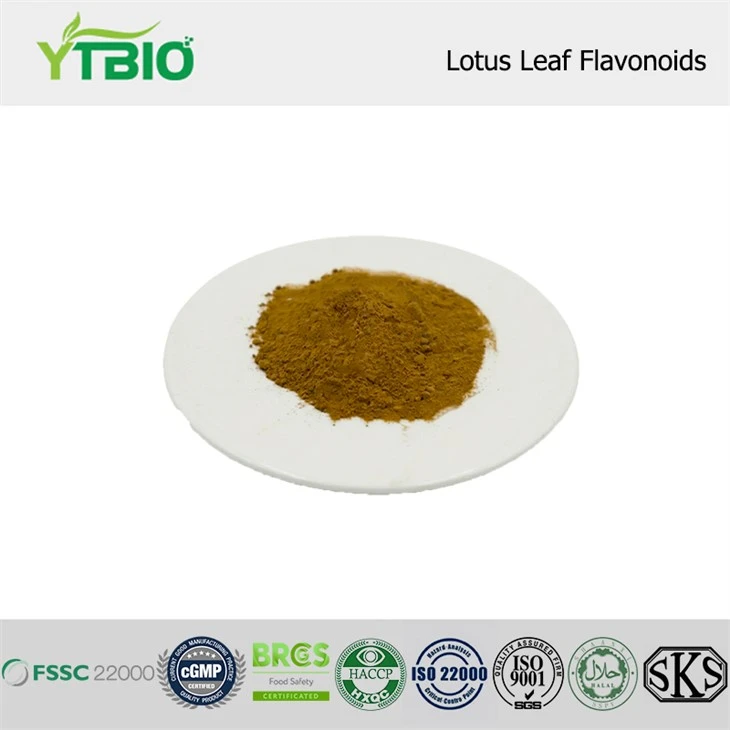
Shaanxi Yuantai Biological Technology Co., Ltd. is one of the most reliable manufacturers and suppliers of lotus leaf flavonoids in China. With abundant experience, we warmly welcome you to wholesale bulk lotus leaf flavonoids for sale here from our factory. Quality products and reasonable price are available.
Product Description
Lotus leaves are rich in carbohydrates, phenolic compounds, lipids, and other substances, and also contain a variety of bioactive substances that can have beneficial effects on the human body. Among them, the most important are lotus leaf flavonoids, which have antioxidant, antiviral, blood pressure-lowering, and fat-reducing effects, and have important research value in the food and medical fields.

YTBIO has focused on the research and supply of plant extracts for 12 years, providing high-quality Lotus Leaf Extract Flavonoid to global customers. Our standardized flavonoid content is 20%, and the activity is stable. We also support OEM/ODM customization services based on related health ingredients, offering customized services for different specifications, dosage forms (capsules, tablets, powders, gummies, etc.), formulations, and packaging according to customer needs.
Product details
At least ten flavonoids, including quercetin, kaempferol, rutin, quercetin-3-O-glucuronic acid, quercetin-3-propyl ester, isoquercitrin, and hyperoside, have been isolated from lotus leaves. The main flavonoid is nuciferol, followed by common flavonoids such as quercetin and isoquercitrin.
|
Item |
Specification |
|
Product Name |
Lotus Leaf Flavonoids |
|
Botanical Name |
Nelumbo nucifera Gaertn. |
|
Plant Part |
Leaf |
|
Specification |
Flavonoids 20% |
|
Test Method |
UV |
|
Appearance |
Brown Yellow Powder |
|
Solubility |
Water Dispersible |
|
Grade |
Food Grade |
|
Shelf Life |
24 Months |
|
Storage |
Store in a Cool, Dry Place Away from Light |
Functions and Market Prospects of Lotus Leaf Flavonoids
Due to their rich content of plant-based active ingredients and potential health benefits, lotus leaf flavonoids have gained attention in recent years in the fields of dietary supplements, functional foods, and health drinks.
Weight Management
Lotus leaves have long been used in traditional teas and health foods. Lotus leaf flavonoid extract exhibits certain pancreatic lipase inhibitory activity, which may be related to lipid metabolism regulation. Therefore, lotus leaf flavonoids are frequently used in the development of weight management products.
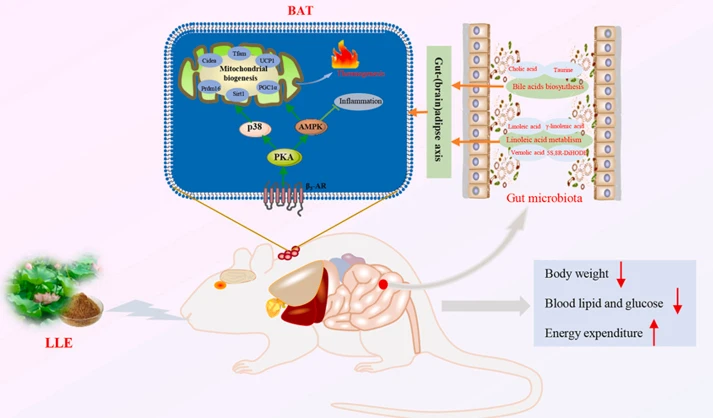
A study systematically evaluated the anti-obesity effects and mechanisms of lotus leaf extract (LLE), rich in flavonoids, in a mouse model induced by a high-fat diet. Results showed that LLE significantly inhibited weight gain, reduced fat deposition, improved glucose and lipid metabolism disorders, and increased energy expenditure. LLE improved the morphology of brown adipose tissue, enhanced the expression of thermogenesis-related molecules such as SIRT1, PGC-1α, and UCP1, and activated the β3-AR/AMPK/p38 signaling pathway, thereby promoting brown adipose tissue thermogenesis. Simultaneously, LLE also remodeled the gut microbiota imbalance caused by a high-fat diet and regulated metabolic pathways related to bile acid and lipid metabolism; its anti-obesity effect was significantly gut microbiota-dependent.
Reference:Wang Z, Ren X, Peng Z, et al. Flavonoid-rich Extracts of Nelumbo nucifera Leaves Alleviate Obesity in HFD-fed Mice via Microbiota-dependent Modulation of Brown Fat Thermogenesis. Journal of Ethnopharmacology. 2026;354:120513. DOI:10.1016/j.jep.2025.120513.
Antioxidant Support
Lotus leaf flavonoid are rich in natural flavonoids and have excellent antioxidant properties, helping to resist oxidative stress from free radicals.
A study explored the in vitro antioxidant activity of lotus leaf flavonoid by measuring their scavenging ability against DPPH• and •OH, total reducing power, and anti-lipid oxidation ability. The results showed that lotus leaf flavonoid exhibited good scavenging ability against 1,1-diphenyl-2-trinitrophenylhydrazine radicals (DPPH•) and •OH, with half-maximal inhibitory concentrations (IC50) of 0.8847 and 1.1445 g/L, respectively. Lotus leaf flavonoids also possess strong reducing power.
This indicates that lotus leaf flavonoid possess good antioxidant activity and can be used as natural antioxidants. This study provides a certain reference for the further development and utilization of lotus leaf flavonoids.

Reference:Zhang H, Zhao D, Wang D, Zhu W. Ultrasonic Assisted Ionic Liquid Extraction of Flavonoids from Lotus Leaf and Assessment of Its Antioxidant Activity. Fine Chemicals. 2023;(10).
Antibacterial Activity Support
Lotus leaf flavonoids have certain antibacterial properties, helping to maintain a healthy microenvironment. Their effectiveness may be affected by factors such as temperature, pH, and extraction process. This characteristic gives lotus leaf flavonoids certain application potential in the food industry.
Other Fields
There are also related experimental studies on lotus leaf flavonoids in areas such as blood sugar regulation and neurological health.
Some animal experiments show that lotus leaf flavonoids may have a certain impact on blood sugar level regulation; at the same time, in studies of anxiety-related animal models, the active ingredients of lotus leaf have also been observed to have a certain regulatory effect. However, its specific mechanism of action and human application effects still need further research and verification.
Application Prospects
As a plant extract with a traditional application foundation and modern research value, lotus leaf flavonoids are gradually being applied to weight management dietary supplements, functional beverages, and antioxidant health foods, possessing good potential for functional food development.
Application Forms
Currently, the main dosage forms of lotus leaf extract health products on the market include: compressed candy, compound powder, capsules, various health teas, and fruit juices.
Food Additives: Lotus leaf flavonoid can be used as natural food preservatives, extending shelf life and providing certain health benefits through their antibacterial and preservative properties.
Feed Additives: Adding lotus leaf flavonoids to livestock, poultry, and aquatic feed can increase feed intake and improve meat quality.
Medical: Lotus leaf flavonoids are also used as an adjunct treatment for chronic diseases such as hyperlipidemia, obesity, and diabetes.
Skincare ingredient: Due to its antioxidant properties, it is also used in skincare products to help improve skin condition and delay skin aging.

contact us
YTBIO offers high-quality Lotus Leaf Flavonoids (20%) and professional OEM/ODM solutions. Contact us now for samples, technical information, and the latest quote.
Telephone/WhatsApp:+8617782577059
Email:Sales@Sxytbio.Com
Hot Tags: lotus leaf flavonoids, China lotus leaf flavonoids manufacturers, suppliers, factory