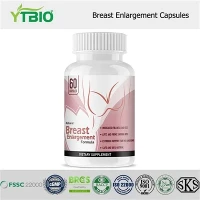

If you've ever browsed the health supplement aisle-online or in-store-you've likely noticed private label softgels popping up alongside more well-known branded products. Maybe you've picked up a bottle of something like Breast Enlargement Capsules without thinking twice, or maybe you've hesitated, wondering: Are these private label softgels actually safe to consume? As the owner of a softgel OEM and private label manufacturer, I get this question all the time. It's not just a curious consumer query; it's a concern that shapes everything we do in our facility, from raw material sourcing to the final packaging of every softgel that leaves our production line. Let me break down what makes private label softgels safe, what you should look for, and why not all softgel manufacturers are created equal.
First, it's important to define what private label softgels are, just to set the stage. Private label products are made by one company (that's us, in this case) and sold under another brand's name-think of a small health practitioner creating their own line of NAD+ Capsules or R-lipoic Acid Capsules, or a boutique wellness brand launching a line of stress support supplements. Softgels themselves are a popular dosage form because they're easy to swallow, can hold a wide range of ingredients (oils, powders, extracts), and the gelatin or vegan soft shell protects sensitive ingredients from degradation. But their safety isn't just about the ingredients inside-it's about every step of the process, from the moment we source raw materials to the day a consumer opens the bottle.
Let's start with raw materials, because that's where safety begins. No softgel, private label or branded, can be safer than the materials that go into it. At our facility, we don't cut corners here. We work only with suppliers who are GMP (Good Manufacturing Practices) certified, and we require third-party testing for every single raw ingredient that comes through our doors. That means testing for contaminants like heavy metals, pesticides, microbials, and fillers that aren't listed on the product label. For example, when a brand comes to us with a request for Ashwagandha Capsules, we test each batch of ashwagandha root extract to make sure it doesn't have excess lead or unlisted solvent residues from extraction processes. The same goes for the soft shell itself: we use either food-grade gelatin (from bovine or pork sources, with full traceability) or plant-based ingredients like algin and carrageenan for vegan products, all of which meet FDA and EU food safety standards. Too many unethical private label manufacturers skip this step, buying cheap, untested ingredients to lower costs. But that's a risk we'll never take-because a consumer who takes a softgel doesn't care if the brand is "private label" or not; they just want to know it's safe for them.

Next, there's the manufacturing process itself. Making softgels isn't as simple as mixing ingredients and pouring them into a shell; it's a precise, automated process that requires strict quality control at every stage. We use a rotary die encapsulation machine, which is the industry standard for consistent, defect-free softgels. During this process, two flat sheets of the soft shell are fed into the machine, along with a stream of the liquid or semi-solid supplement inside. The machine cuts the shell into individual softgels, seals them, and polishes them-all while maintaining exact temperatures to prevent the ingredients from breaking down and the shell from melting. But even with automation, human oversight is critical. Our quality control team checks every hour for softgels that are over-sealed, under-sealed, have air bubbles, or the wrong fill volume. We also test for cross-contamination between batches. For example, if we were running a batch of Soft Capsule Wrapped Tablets one day, we thoroughly clean all equipment before switching to a batch of elderberry softgels, to make sure no traces of the previous product are left behind. Cross-contamination is a major safety risk that many private label facilities overlook, but it's non-negotiable in our operation.
Then there's third-party testing and labeling transparency. A lot of private label brands assume that because we're the manufacturer, we're doing all the testing-but we go above and beyond to provide our clients with full test results for every batch. That includes potency testing (to make sure the softgel has the amount of ingredient listed on the label), purity testing (no contaminants), and stability testing (to confirm the softgel stays safe and effective until the expiration date). We also comply with all relevant regulations, depending on where the product will be sold. For products in the U.S., we follow FDA guidelines for dietary supplements; for Europe, we align with EFSA standards; and for other markets, we adjust our processes to meet local requirements. Too often, I see private label products with vague labels or claims that aren't backed by science. For example, a bottle of "breast enlargement capsules" that doesn't list any active ingredients, or a NAD+ Capsule that claims to have 500mg of NAD+ but only has 100mg. That's not just misleading-it's unsafe. Our clients are encouraged to make evidence-based claims, and we provide them with the data to back up every statement on their labels.
Another common question I get: Are vegan private label softgels safe? With more consumers choosing plant-based supplements, vegan soft shells are becoming increasingly popular, but there's a lot of misinformation about them. At our facility, we make vegan softgels using ingredients like algae-derived gelatin (agar) or cellulose, and we test these shells to make sure they meet the same safety standards as animal-based gelatin. They're also just as easy to swallow and seal properly, so there's no risk of the inside ingredient leaking. We've seen a lot of brands launch vegan lines with cut-rate vegan shells, which can be brittle, break easily, or leach unwanted substances into the supplement. But we've invested in high-quality vegan shell materials that are both safe and consistent, so our clients' vegan softgel products are as safe as any other.
I also want to talk about storage and handling, because safety doesn't end when the softgel leaves our facility. We provide our private label clients with detailed storage instructions-keep softgels in a cool, dry place, away from direct sunlight and high humidity. We also recommend that they use child-resistant packaging, especially for products targeted at families or older adults. We've had clients come to us with questions about why their softgels are melting or discoloring after they receive them, and it's almost always due to incorrect storage. That's why we make sure to educate our clients every step of the way, because even the safest softgel can become unsafe if it's stored in a hot car or a damp basement.
Now, let's address the other side: the risks that come with buying private label softgels from unvetted manufacturers. I've seen first-hand what happens when a manufacturer cuts corners. Last year, I worked with a small wellness brand that had previously used a different private label softgel supplier. They started getting complaints from customers who reported stomach cramps and nausea after taking their ashwagandha softgels. When we tested a batch from the previous supplier, we found high levels of residual solvent from the extraction process-something the cheap supplier had skipped testing for. That brand had to recall their entire line, which cost them thousands of dollars and damaged their reputation. That's why I always tell brands that choosing a private label softgel manufacturer isn't just about price; it's about safety. At our facility, we charge a fair price, but we never sacrifice quality to undercut competitors. For us, safety isn't an afterthought-it's the foundation of our business.
So, what should a consumer look for when buying private label softgels? First, check for a batch number and expiration date-those are key for traceability. If a bottle doesn't have a batch number, it's a red flag. Second, look for brands that use reputable private label manufacturers. If a brand makes Breast Enlargement Capsules or any other supplement, and they don't disclose their manufacturer (or the manufacturer has a history of recalls), that's another red flag. Third, read the label carefully. If the claims sound too good to be true (like "cures anxiety in 24 hours"), they probably are. And finally, if you have any pre-existing health conditions or take medication, talk to your doctor before taking any new supplement, private label or otherwise.
At the end of the day, private label softgels can be just as safe, if not safer, than branded products. Because many private label brands are small, independent companies that care deeply about their customers, and they work with manufacturers who prioritize safety over profit. As a softgel OEM and private label supplier, we're proud to partner with these brands to create safe, high-quality supplements that help people feel their best. Whether a brand is launching a line of R-lipoic Acid Capsules for antioxidant support, Soft Capsule Wrapped Tablets for targeted delivery, or any other product, we make sure every softgel that leaves our facility meets the highest standards of safety and quality.
If you're a brand looking to launch your own private label softgel line, or if you have questions about our manufacturing process, we're here to help. We offer transparent testing, GMP-certified facilities, and a team of experts who can guide you through every step of the process, from formulation to packaging. Don't settle for a manufacturer that cuts corners on safety-partner with a team that puts consumer well-being first. We're ready to hear from you and help create a product your customers can trust.
Telephone/WhatsApp:+8617782577059
Email:sales@sxytbio.com
References
- U.S. Food and Drug Administration. (2023). Current Good Manufacturing Practice in Manufacturing, Packaging, Labeling, or Holding Operations for Dietary Supplements. Retrieved from fda.gov
- European Food Safety Authority. (2022). Guidance on Safety Assessment of Botanicals Used in Food and Dietary Supplements. Retrieved from efsa.europa.eu
- International Organization for Standardization. (2021). ISO 22000: Food Safety Management Systems Requirements. Retrieved from iso.org
- National Center for Complementary and Integrative Health. (2023). Common Supplement Safety Concerns. Retrieved from nccih.nih.gov
- Softgel Capsules Association. (2022). Best Practices for Softgel Manufacturing and Quality Control. Retrieved from softgelassociation.org