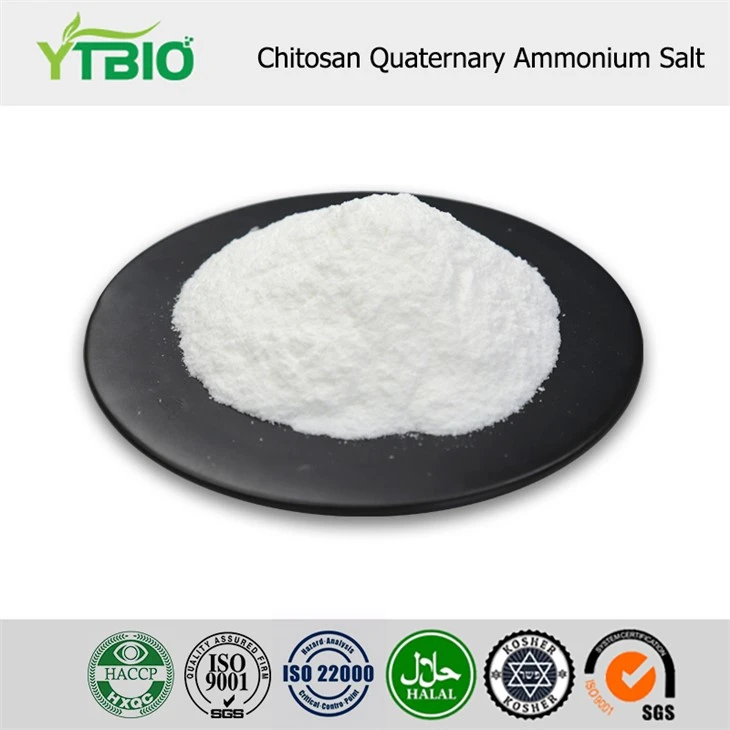
Shaanxi Yuantai Biological Technology Co., Ltd. is one of the most reliable manufacturers and suppliers of chitosan quaternary ammonium salt in China. With abundant experience, we warmly welcome you to wholesale bulk chitosan quaternary ammonium salt for sale here from our factory. Quality products and reasonable price are available.
What is Chitosan quaternary ammonium salt?
Chitosan Quaternary Ammonium Salt is a high-grade chitosan derivative obtained through chemical modification. Its full name is hydroxypropyltrimethylammonium chloride chitosan. This product is safe, non-toxic, biocompatible, biodegradable, and possesses antibacterial properties.

Chitosan quaternary ammonium salts possess excellent antibacterial, film-forming, conditioning, hygroscopic, biocompatible, biodegradable, flocculating, and antistatic properties. They also exhibit good water solubility, dissolving under both acidic and alkaline conditions, and the solutions remain stable without discoloration or degradation, making them potentially valuable for applications in high-end cosmetics and topical bactericides.
Products Description
|
Items |
Standard |
Results |
|
Assay |
99% |
99.21% |
|
Physical & Chemical |
|
|
|
Appearance |
White powder |
Conform |
|
Odor |
Characteristic |
Characteristic |
|
Particle Size |
98% pass 80mesh |
Complies |
|
Loss on Drying |
≤5.0% |
3.43% |
|
Ash |
≤5.0% |
1.87% |
|
Solvent Residue |
Meet USP standard |
Complies |
|
Pesticide Residue |
Meet USP standard |
Complies |
|
Heavy Metal |
|
|
|
Lead (Pb) |
≤2.0ppm |
Conform |
|
Microorganism |
|
|
|
Total Plate Count |
≤1000cfu/g |
Conform |
|
Yeasts and Molds |
≤100cfu/g |
Conform |
|
Saimonella |
Negative/25g |
Conform |
|
E.coli |
Negative |
Conform |
Mechanism of Action
1. Mechanism of Action
After quaternization, chitosan becomes a high-charge-density polycation, which adsorbs onto the negatively charged bacterial surface through electrostatic interactions. Its bactericidal pathway depends on molecular weight:
 High molecular weight: Forms a polymer film on the cell surface, hindering the exchange of matter and energy.
Low molecular weight: Penetrates the cell membrane and enters the interior, binding to the anionic cytoplasm and disrupting growth.
2. Effect of Environmental pH
Bactericidal activity is stronger in a weakly alkaline environment. This is because alkaline conditions cause microbial proteins to carry more negative charges, enhancing the electrostatic interaction between the polycation and the cytoplasm.
3. Less Effective Against Gram-Negative Bacteria
It is less effective against Gram-positive bacteria such as Staphylococcus aureus than against Escherichia coli and Pseudomonas aeruginosa (Gram-negative bacteria). This is because the cell walls of Gram-positive bacteria are mainly composed of a peptidoglycan layer, which readily contacts the chitosan quaternary ammonium salt. Gram-negative bacteria have an outer lipopolysaccharide (LPS) layer, which strongly hinders the entry of foreign macromolecules. Furthermore, chitosan quaternary ammonium salt is highly hydrophilic and weakly lipophilic, making it difficult to penetrate this barrier.
Core Advantages in Application Areas
1. Antibacterial Activity: Exhibits stronger and broader-spectrum antibacterial activity against both Gram-positive and Gram-negative bacteria, unaffected by environmental pH (chitosan has almost no antibacterial activity at physiological pH ≈ 7.4).
2. Flocculation/Water Treatment: More efficient and widely applicable as a flocculant for treating negatively charged colloidal particles (such as sewage, sludge, and dye-containing wastewater) (no need to adjust pH to acidity).
3. Drug Delivery: Binds more strongly to negatively charged drug molecules (such as DNA, RNA, and protein drugs), forming more stable complexes or nanoparticles.
4. Gene Transfection: Typically exhibits higher cellular uptake efficiency when used as a non-viral vector for DNA/RNA delivery.
5. Cosmetics/Personal Care: Provides excellent adsorption, film-forming, and antistatic properties over a wider pH range as a cationic conditioner and skincare product.
6. Papermaking additives: Superior performance of reinforcing agents, retention and filtration aids, sizing agents, etc.

Preparation method
The preparation method of chitosan quaternary ammonium salt comprises:
Dissolve chitosan in water at a ratio of 1g:25mL, stir and dissolve at 40℃, adjust pH to 7 with NaOH, continue stirring for 30min, add 5% HAc at a ratio of 1g:25mL, stir at 40℃ for 1h, then add 0.2g of dehydrated glyceryl trimethyl ammonium chloride, heat at 100℃ and 420W microwave for 3min, precipitate the product with acetone, filter and dry.
Preferably, the dehydrated glyceryl trimethyl ammonium chloride is prepared by the following method:
Stir epichlorohydrin in an ice bath for 0.5h, pass dry trimethylamine gas at a molar ratio of 1:2, pass it within 1h, continue to stand in an ice water bath for 0.5h, stir at 20℃ for 4h, then immediately filter, wash the product with acetone, vacuum dry, and quickly move it into dry promotional materials.
In the method of the present invention, the whole reaction time is short, the prepared chitosan quaternary ammonium salt has a high substitution degree, can be used as a flocculant to treat papermaking white water, achieves a good flocculation effect, and the COD removal rate is 85%.
contact us
YTBIO mainly supplies Chitosan quaternary ammonium salt etc. The company was established in 2014 and has many years of R&D and production experience. We are committed to the research and development, production and sales of raw materials for the 21st century health industry. The certificates obtained so far include ISO9001, ISO22000, HALAL, KOSHER, FDA,etc. We always maintain the highest requirements for product quality.
Tel:86-029-86478251 / 86-029-86119593
Whatsapp:8617782577059
Email:sales@sxytbio.com
Hot Tags: chitosan quaternary ammonium salt, China chitosan quaternary ammonium salt manufacturers, suppliers, factory