What is Fucoxanthin ?
Fucoxanthin powder is a natural pigment of the lutein class among carotenoids, accounting for more than 10% of the total number of natural carotenoids, about 700 types. The color is light yellow to brown and is a pigment contained in brown algae, diatoms, golden algae, and yellow-green algae. It is a pigment contained in brown algae diatoms, golden algae and yellow-green algae. It participates in the photochemical system of photosynthesis II. Reddish-brown crystals can be obtained, which is a form of lutein, a brown substance found in brown algae. It can be said that it is a pigment unique to brown algae, and is sometimes dispersed in algae such as diatoms. Sometimes confused with phycoerythrin, phycoerythrin is thought to be a water-soluble pigment unique to brown algae and appears to be a hypothetical substance. It seems to refer to the yellow-brown substance formed when the phenolic substances contained in brown algae are oxidized after the plant dies. So they are fundamentally different.

Fucoxanthin is a special lutein extracted from edible brown seaweed and some microalgae. Due to its biological function and unique structural properties, including epoxy, isopropyl and acetyl base and attracted much attention. Scientists found that fucoxanthin provided relatively better performance than lutein in protecting the retina from damage caused by visible light, both in vitro and in vivo. Kelp is a common brown algae that contains fucoxanthin.
It is a natural pigment of the lutein class among carotenoids. It is orange-red in color and is a pigment contained in brown algae, diatoms, golden algae and yellow-green algae. Seaweeds such as kelp and wakame are rich in fucoxanthin.
Fucoxanthin not only has antioxidant effects, but its anti-obesity and anti-diabetic effects have also been verified, and has received widespread attention from the market. Other studies have also shown neuroprotective and anti-inflammatory effects.
The role of fucoxanthin in supporting weight management has been clinically verified. At the same time, the mechanism of weight loss has been further confirmed at the gene expression level through animal experiments.
In a randomized, double-blind study, subjects took either 4 mg of fucoxanthin in hard capsules or a placebo daily. Without dieting, additional exercise or other lifestyle changes, compared with the placebo group, the subjects in the experimental group lost significantly more weight, and CT scans showed a reduction in abdominal fat and visceral fat area, suggesting a fat-burning effect. Of particular interest was the 30-day follow-up survey that found no weight gain among these subjects.
Test report


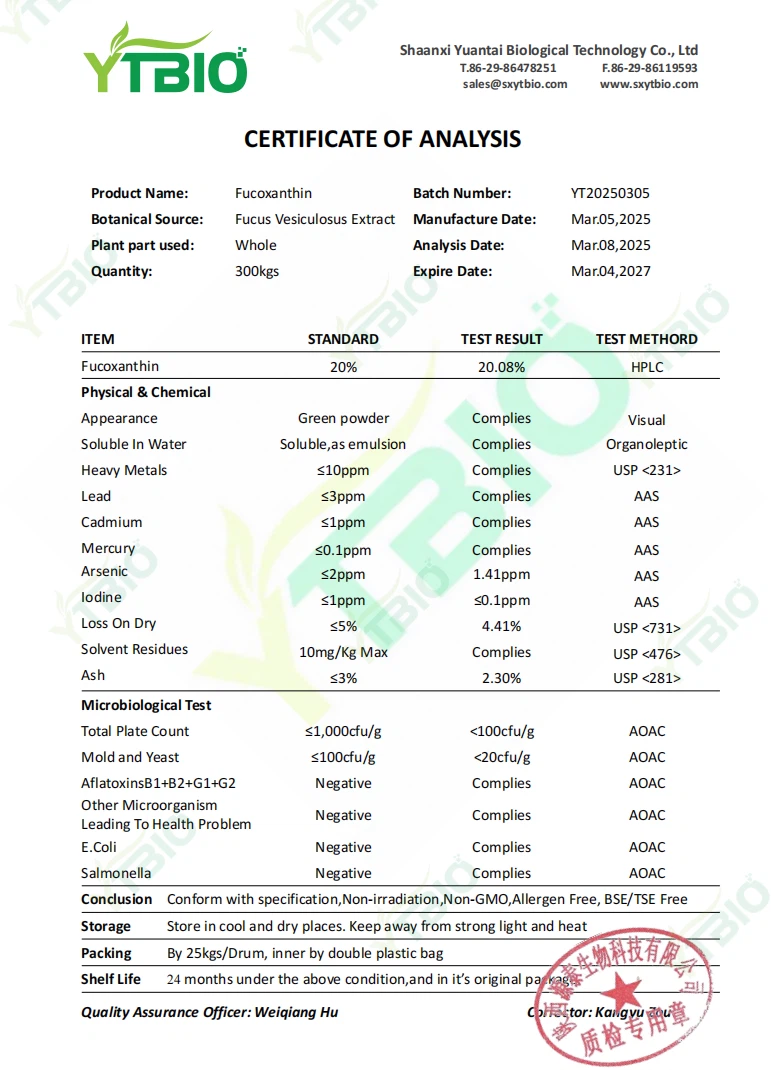
Please feel free to contact us for more specifications and information.
What are the benefits of Fucoxanthin ?
1. Fucoxanthin can burn fat cells and eliminate fat accumulation in two ways: (1) Reduce the weight of abdominal white adipose tissue (WAT); (2) It can mediate the expression of mitochondrial uncoupling protein 1 (UCPl) and Promote fat decomposition, thus exerting significant weight loss effects, making fucoxanthin occupy an important position in the weight loss market.
2. In terms of weight loss and blood sugar regulation. Fucoxanthin can improve insulin resistance and reduce blood glucose levels by regulating the secretion of cytokines in WAT
3. It can also reduce the levels of cholesterol and triglycerides in the body and play a role in lowering blood lipids. Therefore, fucoxanthin is a potential functional ingredient with hypolipidemic activity.
4. It has a strong scavenging effect on DPPH free radicals, has antioxidant activity, and has a high scavenging effect on free radicals.
5. Inflammation is the body's defense response to stimulation, which is mainly manifested by redness, swelling, heat, and pain. Vascular responses are central to the inflammatory process. The anti-inflammatory response is to reduce the inflammatory response by inhibiting the production of inflammatory cytokines and inflammatory mediators. These inflammatory cytokines include tumor necrosis factor-α, interleukin-1β, and interleukin-6, and inflammatory mediators include nitric oxide induced by NO synthase and prostaglandin E2 catalyzed by cyclooxygenase.
6. After supplementing fucoxanthin, blood pressure decreased, liver fat storage and liver enzyme values decreased.
7. Protects the body from the effects of aging and disease
The antioxidant capacity of fucoxanthin, in addition to preventing aging by inhibiting reactive oxygen species produced in the body, also helps prevent cardiovascular diseases such as arteriosclerosis, stroke and myocardial infarction. Reactive oxygen species have the effect of destroying bacteria and viruses that enter the human body, so they are necessary for the human body. However, if increased too much, its powerful effect can damage cells, leading to lifestyle-related diseases and aging.
8. Effect of preventing metabolic syndrome
Fucoxanthin has also been used to prevent metabolic syndrome. There are two types of fat cells: white fat cells and brown fat cells, each with different functions. The role of white fat cells is to convert excess accumulated energy into fat, while brown fat cells maintain body temperature and consume extra energy by breaking down fat and generating heat.
9.Diabetes prevention effect
Fucoxanthin has a preventive effect on diabetes. We know that fucoxanthin has the effect of promoting sugar metabolism and lowering blood sugar levels. In addition, studies have shown that fucoxanthin intake inhibits the secretion of lipokine, which is associated with an increase in blood sugar levels.
Fucoxanthin is believed to help promote sugar metabolism and inhibit the secretion of lipokine, thus preventing diabetes.
10.anti-oxidation
Carotenoid pigments basically have antioxidant activity. The antioxidant activity of carotenoids is related to the number of oxygen atoms in the molecule. Especially in anoxic environment, the antioxidant ability of fucoxanthin is not found in other pigments. In addition, the antioxidant properties of fucoxanthin also include the quenching of singlet oxygen and scavenging of free radicals. Fucoxanthin can effectively scavenge chemically generated free radicals. Fucoxanthin has good antioxidant effects, even better than vitamin E and vitamin C. Fucoxanthin has a protective effect on human fiber cell damage caused by UV-B. The antioxidant effect of fucoxanthin is mainly through regulating the activity of Na+-K+-ATPase, as well as the activity of catalase and glutathione in tissues and molecules caused by retinol deficiency.
11.Anti-inflammatory
Fucoxanthin has an inhibitory effect on the infiltration of endotoxin-induced inflammatory mediators in a dose-dependent manner. Its anti-inflammatory effect is comparable to that of prednisolone, indicating that fucoxanthin has an inhibitory effect on endotoxin-induced inflammation in mice. Has a certain inhibitory effect. Its anti-inflammatory effect is mainly through inhibiting the inflammatory reaction NO leakage caused by lipopolysaccharide-induced macrophages. RT-PCR analysis showed that the mRNA of NO synthase and cyclooxygenase were inhibited by fucoxanthin, and, The expression of leukocyte intermediaries IL-1β and IL-6, and mRNA survivin were inhibited by fucoxanthin in a dose-dependent manner. These results indicate that fucoxanthin may play an important role in a variety of inflammatory reactions.
Features
1. Absorption and metabolism
Fucoxanthol and AmarouciaxanthinA were the main primary metabolites. The ingested fucoxanthin is hydrolyzed into fucoxanthin under the action of digestive enzymes (such as lipase and cholesterol esterase) in the gastrointestinal tract, which then enters the systemic circulation through the lymph, and part of the fucoxanthin is degraded into AmarouciaxanthinA in the liver. Flavonol and Amarou-ciaxanthinA are then further metabolized by enzymatic reactions such as isomerization, dehydrogenation, deacetylation, oxidation and demethylation.
2. Security
It has no effect on liver, kidney, spleen and gonad tissue, but can cause hypercholesterolemia. Fucoxanthol has no in vitro teratogenicity, and fucoxanthin has no in vivo teratogenicity at doses of 500, 1000, and 2000 mg/kg.
3. Stability
High-purity fucoxanthin is unstable to heat and easily oxidized. However, the fucoxanthin powder obtained from algae is stable due to the co-existence of antioxidant substances (such as polyphenols, etc.). Sensitive to light, the stability is greatly improved when stored in the dark. At the same time, other antioxidants protect the fucoxanthin pigment from degradation. In addition, it is more stable than neutral and acidic in alkaline pH conditions, with the greatest stability at pH 9 and the least stable in acidic conditions. Fucoxanthin in seaweed is stable during dry processing and storage at room temperature.
Application of Fucoxanthin
1. In the field of health food, it is widely used in the food additive industry. It can be added to dairy products, drinks, medical care products, cakes, cold drinks, jelly, bread, milk, etc.;
Improve food color
Fucoxanthin itself is a natural pigment that can make food appear orange. It is a commonly used food coloring agent for humans and has a wide range of applications in the food field. In recent years, fucoxanthin has been commonly used in the processing of baked goods such as butter, pies, green tea cakes, etc., to improve the color of the food. Fucoxanthin can effectively inhibit the lipid peroxidation reaction of chicken breast during cooling and storage after cooking, preventing color changes in the chicken while giving the chicken red and yellow colors. Fucoxanthin can also be used as an egg yolk colorant and added to poultry feed to improve the color of egg products. In addition, in order to reduce the risk of nitrosamine formation during the curing process, natural pigments such as fucoxanthin are usually added to cured meat products to reduce the addition of nitrite.

Prevent food from oxidative deterioration
As we all know, the oxidation of fatty acids and lipids dominated by free radicals is the main cause of food deterioration; the oxidation of oils and fats by active oxygen species such as superoxide anions and hydroxyl radicals shortens the shelf life of food, which has attracted widespread attention in the food industry. Fucoxanthin can be added to food as a natural antioxidant to reduce the occurrence of lipid peroxidation during food processing and storage. Adding fucoxanthin during the processing of chicken can effectively inhibit lipid peroxidation that occurs during refrigeration of processed chicken. Studies have found that fucoxanthin can also inhibit lipid oxidation in chicken sausages during storage, effectively preventing the formation of thiobarbituric acid. Fucoxanthin can effectively inhibit the production of malondialdehyde in fish oil and lard in the oxidation model, with the highest inhibition rates of 78.1% and 80.9% respectively. The results indicate that fucoxanthin can be used as a safe natural antioxidant added to In food, to solve the problem of deterioration caused by lipid oxidation.
Develop weight loss products
The most prominent physiological activity of fucoxanthin is its anti-obesity activity, so most of the products developed are weight loss products. In addition, weight loss products that combine fucoxanthin with other functional ingredients are also popular in the market. A product that combines fucoxanthin with pomegranate seed extract has been proven to have a lipid-lowering effect on mice and humans. In addition to food, fucoxanthin is also formulated into hydrogel patches for the prevention and treatment of obesity.
Make low GI foods
As a type of carotene, fucoxanthin, like other carotenoids, has potential anti-diabetic activity and can effectively inhibit the increase in blood sugar. It was created in the development of low glycemic index (GI) foods. condition. Although the incidence of diabetes is increasing year by year, there are still significant reports on the application of carotenoids such as fucoxanthin in low GI foods. Develop a carotenoid mixture with zeaxanthin, diatomaxanthin, isoflavin, etc. as active ingredients, which can be added to high GI foods for consumption to inhibit the rise in blood sugar. A tablet candy with fucoxanthin, soy lecithin and fructooligosaccharide soluble dietary fiber as the main raw materials was developed. So far, there is no method that can completely cure diabetes, and it can only focus on control. The use of fucoxanthin to develop low-GI foods suitable for diabetics is still a hot issue in the application research of fucoxanthin in food.
2. In the field of makeup fields, it is a natural extract of water -soluble polymers, which increases efficacy and promote skin levels;
3. Application in the field of drugs is a raw material for new traditional medicine, which is usually added to kidney products.
If you are interested in YTBIO's fucoxanthin or other raw materials, please feel free to contact us via online consultation or email. We will provide you with professional technical support and customized solutions.
Telephone:+8617782577059
Email:sales@sxytbio.com
Hot Tags: fucoxanthin powder, China fucoxanthin powder manufacturers, suppliers, factory