



Shaanxi Yuantai Biological Technology Co., Ltd. is one of the most reliable manufacturers and suppliers of astragalus polysaccharide powder in China. With abundant experience, we warmly welcome you to wholesale bulk astragalus polysaccharide powder for sale here from our factory. Quality products and reasonable price are available.
About The Detailed Introduction Of Astragalus polysaccharide?
Astragalus polysaccharide powder is a water-soluble heteropolysaccharide obtained by extracting, concentrating, and purifying the dried roots of the leguminous plant Astragalus mongolica or Astragalus membranaceus. It is light yellow, has fine powder, is uniform, free of impurities, and has hygroscopic properties. Astragalus polysaccharide is composed of hexuronic acid, glucose, fructose, rhamnose, arabinose, galacturonic acid and glucuronic acid. It can be used as an immune promoter or regulator and has anti-viral, anti-aging, anti-radiation, and anti-inflammatory properties. Stress, antioxidant and other effects.
Astragalus polysaccharide is an active ingredient of traditional Chinese medicine extracted from the leguminous plant Astragalus mongolica or Astragalus membranaceus. It contains astragalus polysaccharide based on glucose (C6H12O6). The oral liquid grade should not be less than 65%, and the injection grade should not be less than 70 %. Astragalus is a traditional Chinese medicine that replenishes qi. It has been confirmed that the astragalus polysaccharide, choline and multiple vitamins contained in it can significantly improve the function of human white blood cells in inducing interferon, regulate body immunity, and promote the formation of antibodies. By regulating and inducing interferon, it destroys viruses in the body to achieve therapeutic effects. Astragalus polysaccharide injection can be used to treat mutated viral colds, acute and chronic respiratory diseases in livestock and poultry, and bacterial and mycoplasma infections caused by viral diseases; it can also be used to treat circovirus, PRRS, pericarditis, encephalitis, transmissible gastroenteritis, It also has an auxiliary treatment effect on epidemic diarrhea and mumps; in addition, it has a preventive and remedial effect on pustules on the mouth, nose and feet and failure of vaccination against severe infectious diseases.
Product Details List
| CAS | 89250-26-0 |
| Molecular formula | C10H7ClN2O2S |
| Molecular weight | 254.69 |
| EINECS | 2017-001-1 |
| Melting point | 154.5 °C |
| Boiling point | 406.2±30.0 °C(Predicted) |
| Density | 1.439 |
| Storage conditions | 2-8°C |
| Acidity coefficient (pKa) | 0.32±0.10(Predicted) |
What Are The Benefits?
1. Improve the body's immunity, prevent and treat livestock and poultry immune system syndrome, have the function of promoting animal growth, increase chicken appetite, enhance digestion, improve disease resistance, improve survival rate, and increase feed conversion rate by 9.0% and 10.1%, which can It can significantly increase the egg production rate of laying hens, reduce the feed-to-egg ratio and mortality rate, and improve the production performance of laying hens during the peak egg production period.
2. Astragalus polysaccharide can block the adhesion of Pseudomonas aeruginosa to the respiratory epithelium, repair the tracheal mucosal epithelium of mice with chronic bronchial lesions, and play an anti-Pseudomonas aeruginosa infection role.
3. Certain polysaccharides contained in traditional Chinese medicine are important immune agents, such as ginseng polysaccharide, lentinan, astragalus polysaccharide, velvet antler polysaccharide, etc. Astragalus polysaccharide has a comprehensive enhancement effect on cellular immunity, humoral immunity, molecular immunity, complement immunity, etc., has a preventive effect on patients with frequent colds, and has the effect of correcting toxins in patients with chronic infections, but it can activate antibodies and cause rheumatoid joints. inflammation, Behcet's disease, oral ulcers, and uveitis are aggravated, polymyositis and immune liver disease have significant increases in liver enzyme and muscle enzyme titers such as ALT, AST, and CK, and it is difficult to reduce the fever of adult Still's disease.
4. Two polysaccharides isolated from Astragalus polysaccharide, Astragalus polysaccharide-Ⅰ and Astragalus polysaccharide-Ⅱ, both significantly reduce the activity of alkaline ribonuclease (RNase) in liver and spleen cells, leading to the accumulation of RNA content in tissues. Thereby reducing RNA anabolism.
Enhance immune function
Astragalus, astragalus polysaccharide and astragalus saponin I can enhance and regulate immune function.
(1) Effects on immune organs. Astragalus polysaccharide can significantly increase the spleen weight of mice through injection, and significantly antagonize the atrophy of spleen, thymus, lymph node, etc. in mice caused by methylprednisone (prednisolone).
(2) Effects on macrophages and leukocytes. Astragalus decoction can significantly increase the number and activate phagocytic activity of liver, spleen, lung, and peritoneal macrophages in mice, and induce interleukin-1 (IL). - 1). Intraperitoneal injection of astragalus can significantly prevent and treat the decrease in the number of peripheral leukocytes and bone marrow megakaryocytes in rats caused by cyclophosphamide.
(3) Enhance the effect of T cells. Astragalus polysaccharide can promote the differentiation and maturation of T lymphocytes, and significantly increase their activity, increasing the percentage of T cells in the thymus, and strengthening the functions of T cell subpopulations and helper T cells. And it can completely antagonize the inhibition of T cell subsets and helper T cells by methylprednisone (prednisolone) or cyclophosphamide. Astragalus has a biphasic regulatory effect on T cells, reducing the inhibitory activity of suppressor T cells (Ts) and enhancing the cellular activity of helper T cells (Th).
(4) Improve the effect of inducing interferon. Astragalus decoction can induce γ-interferon, has obvious antiviral activity, and promotes the induction of interferon in mouse L9290 tumor. Treatment of cold patients with astragalus can significantly improve the ability of peripheral blood leukocytes to induce interferon against viruses. Treatment of viral myocarditis with astragalus shows a significant increase in α and γ-interferon. Astragalus and interferon have a synergistic effect on promoting the activity of NK cells. Astragalus polysaccharide can activate the interferon system and induce interferon in lymphocytes.
(5) The effect of enhancing humoral immunity. Astragalus can promote the proliferation of B cells and produce immunoglobulins. Astragalus can significantly promote the production of specific antibodies in the normal body, and oral administration can promote the production of IgG in mice. Normal people taking astragalus can significantly increase the levels of IgM and IgE. Cold patients can significantly increase the levels of IgG and IgA in nasal secretions. Astragalus can increase high IgG in patients with spleen deficiency, but can also reduce high IgG in patients with hepatitis and nephritis to the normal range, suggesting that it regulates antibodies.
Effect on urinary system
Intravenous injection of Astragalus injection can significantly increase serum albumin and significantly reduce serum cholesterol in the rat minimal change nephropathy model, increase the blood supply of glomerular capillary filaments, and also significantly reduce scrotal edema and ascites. , the diet and mental state of the animals in the administration group were also better than those in the control group; Astragalus could significantly reduce the amount of protein in urine; pathological observation also proved that the lesions in the Astragalus group were reduced, and this inhibitory effect on nephritis may be related to the enhancement of metabolism by Astragalus , related to improving the nutritional status of the whole body. Astragalus can reduce renal lesions in spontaneous lupus mice through immunomodulatory effects.
Hepatoprotective effect
Astragalus has the effect of protecting the liver and preventing the reduction of liver glycogen. Two types of astragaloside, ASI and SK, can resist liver damage caused by D-galactosamine and acetaminophen. Astragaloside is the effective component of astragalus against hepatotoxic damage. In addition to resisting biological oxidation, its mechanism is also related to metabolic regulation. Other studies believe that astragalus has a certain effect on preventing liver fibrosis.
Effects on the central nervous system
Subcutaneous injection of astragalus into mice maintained sedation for several hours. Mice drinking 30% astragalus decoction for 15 days can enhance the learning and memory of mice. Experiments show that astragalus is beneficial to the storage of information in the mouse brain.
Effect on smooth muscle
5% and 10% Astragalus decoction can significantly increase the tension, slow down the peristalsis and increase the amplitude of rabbit intestinal tube in vivo; it has an inhibitory effect on isolated rabbit intestinal tube and uterus. Astragalus saponin can reduce the tone of isolated ileum of guinea pigs.
hormone-like effects
Astragalactone and astragalosterol in astragalus extract had no significant effect on the body weight, levator ani muscle or kidney weight of rats and mice, indicating no anabolic hormone or androgen-like effects.
Antibacterial and antiviral effects
Astragalus polysaccharide has a significant antagonistic effect on tuberculosis infection; other ingredients such as amino acids, alkaloids, flavonoids, etc. have been found to have significant anti-follicular stomatitis virus effects. Animal and transchemical cell experiments have shown that Astragalus injection has a certain blocking effect on the infection process of epidemic hemorrhagic fever virus (EHFV) in suckling mice. Astragalus has in vitro effects on Shigella dysentery, Bacillus anthracis, a-active Streptococcus sanguinis, Streptococcus sanguinis, Bacillus diphtheriae, Bacillus pseudodiphtheriae, Diplococcus pneumoniae, Staphylococcus aureus, Staphylococcus citrine, Staphylococcus albus and Bacillus subtilis, etc. Has antibacterial effect.
Impact on trauma infection
Pharmacological experiments on astragalus polysaccharide on experimental mouse trauma showed that it can significantly enhance the phagocytic luminescence intensity of macrophages and inhibit the release of PCE2, further promoting the release of TNF. The combination of the immune activator astragalus polysaccharide and the cyclooxygenase inhibitor ibuprofen not only enhanced the phagocytic luminescence intensity of macrophages, but also significantly inhibited the secretion of PGE2, TNF and IL-1. It can be seen that the combination of immune activators and cyclooxygenase inhibitors is expected to become a new drug treatment option for wound infections.
Regulatory effect on blood sugar
APs have a two-way regulatory effect. It can significantly reduce blood sugar in mice subjected to glucose load, and can also significantly antagonize the elevated blood sugar response in mice caused by epinephrine, and it can also significantly antagonize experimental hypoglycemia in mice caused by phenformin. However, it has no significant effect on insulin-induced hypoglycemia.
antiviral effect
It is an interferon inducer. Its antiviral principle: stimulates the function of macrophages and T cells, increases the number of E-ring-forming cells, induces cytokines, promotes the induction of interleukins, and causes the animal body to produce endogenous interferon to achieve antiviral effects.
antibacterial effect
The mechanism of antibacterial action is multifaceted. On the one hand, it is the direct inhibitory and detoxifying effects of drugs on bacteria and their toxic products. On the other hand, the more important thing is to exert the effect of strengthening the body, eliminating evil, inhibiting bacteria and killing bacteria by mobilizing the body's immune defense function. It has antibacterial effects on Shigella dysentery, Bacillus anthracis, Type A and B Streptococcus pneumoniae, Staphylococcus aureus, Escherichia coli, and Salmonella.
Intestinal health effects
It can increase the number of lactobacilli and bifidobacteria in the intestinal tract of chicks, significantly reduce the number of Escherichia coli, effectively promote the proliferation of beneficial intestinal microorganisms, and inhibit harmful intestinal bacteria. The metabolites are short-chain fatty acids, which can lower intestinal pH. On the one hand, a low pH value can stimulate intestinal peristalsis, thereby reducing the number of pathogenic bacteria. On the other hand, the acidic environment is conducive to the proliferation of beneficial bacteria such as lactobacilli and bifidobacteria. At the same time, the beneficial bacteria produce hydrogen peroxide and organic matter during the proliferation process. Metabolites with antibacterial activity such as acids can inhibit the survival of pathogenic harmful bacteria and exogenous bacteria.
What Are The Application Directions?
Medical field:
Astragalus polysaccharide powder has various pharmacological effects such as immunomodulation, antioxidant, anti-inflammatory, and antibacterial, so it is widely used in the medical field. It can enhance the body's immunity, promote lymphocyte proliferation and spleen cell activity, and improve the body's resistance.

Health care products field:
It is widely used in the field of health products and is often used as one of the main ingredients of health products. It can enhance human immunity, improve the body's resistance, and prevent and improve various diseases. In addition, astragalus polysaccharide also has anti-aging and antioxidant effects, which can delay the aging process of cells and protect organ functions.
Food field:
It can be used in the food field and is often added to various foods, such as beverages, dairy products, pastries, etc. It can increase the nutritional value of food, improve the taste and texture of food, and has certain health care functions.
Cosmetics field:
It also has certain applications in the field of cosmetics. It can promote the metabolism of skin cells, increase the elasticity and luster of the skin, and reduce the occurrence of wrinkles and spots. At the same time, astragalus polysaccharide also has moisturizing, anti-inflammatory, and antioxidant effects, which can improve skin condition and protect the skin from damage from the external environment.
Company Introduction And Certificates Obtained
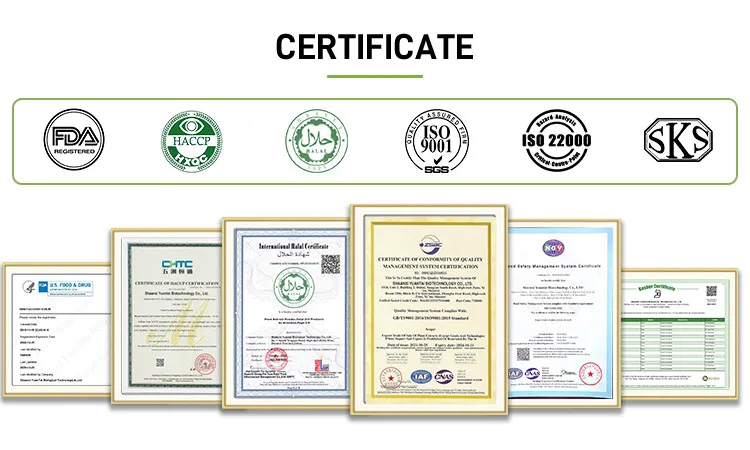
Shaanxi Yuantai Biological Technology Co., Ltd (YTBIO) was established in 2014, mainly supplying Astragalus polysaccharide powder etc. We have our own factories, R&D and quality inspection teams, and have the conditions for development, production, and quality assurance. At present, we have obtained ISO9001, ISO22000, HALAL, KOSHER, HACCP, FDA, and other certificates. Therefore, the quality of our products is guaranteed, and it is our original intention to bring high-quality products to customers.
Our Packaging

Our Team

Factory

Payment Method

Shipping Method

Hot Tags: astragalus polysaccharide powder, China astragalus polysaccharide powder manufacturers, suppliers, factory


