
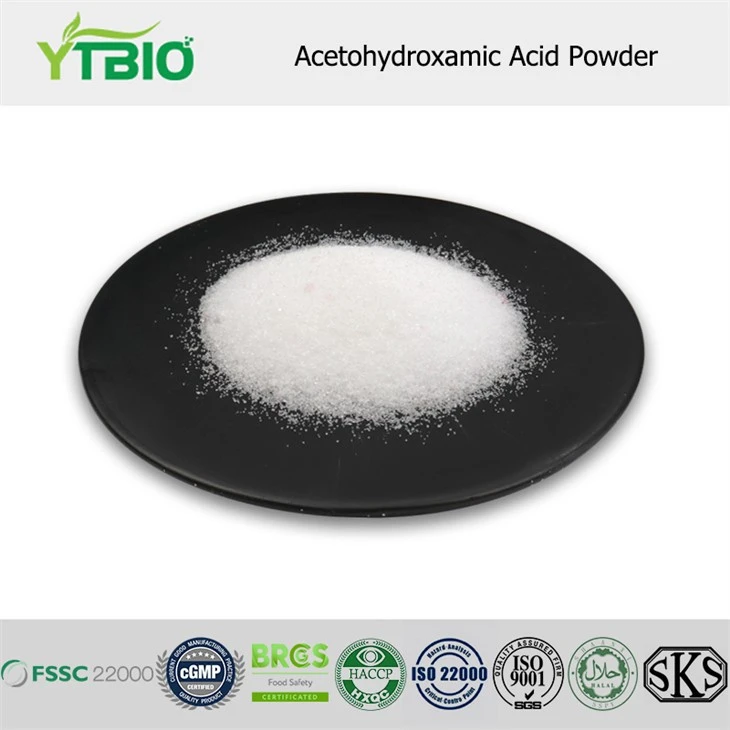
Shaanxi Yuantai Biological Technology Co., Ltd. is one of the most reliable manufacturers and suppliers of acetohydroxamic acid powder in China. With abundant experience, we warmly welcome you to wholesale bulk acetohydroxamic acid powder for sale here from our factory. Quality products and reasonable price are available.
What is Acetohydroxamic acid powder?
This product is white crystal or crystalline powder (orange-red for feed additive grade); almost odorless; slightly bitter; changes color when exposed to light; easily absorbs moisture; easily soluble in water and anhydrous ethanol; aqueous solution shows an acidification reaction. Acetylhydroxamic acid is also known as acetohydroxylamine. In the feed industry, it is used as a rumen microbial urease inhibitor and a feed additive for ruminants. In addition, it is a competitive urease inhibitor in medicine, and its trade name is Junshitong. In the metallurgical industry, it is used as a chelating agent and extractant for the extraction and identification of metal ions.
Application Areas
1. Application of acetohydroxamic acid
Acetylhydroxamic acid is widely used in medicine, animal husbandry, agriculture, environmental protection, metallurgy and other fields.
1.1 Used in the feed industry
Acetylhydroxamic acid is used as a rumen microbial urease inhibitor and is used as a feed additive for ruminants. It was originally included in the USP for the treatment of bacterial bile, kidney stones and hepatic coma. Due to its good rumen microbial urease inhibition, it was initially used in the nutrition of ruminants such as cattle and sheep in the 1990s in the United Kingdom and the United States to improve the rumen ammonia environment, increase protein conversion rate, increase roughage intake, reduce blood ammonia concentration, reduce ammonia stress, and increase body immunity, with good results.
1.1.1 Application of acetohydroxamic acid in dairy cow production
With the improvement of modern dairy cow production level and the expansion of excellent breed coverage, high-yielding dairy cows have higher and higher requirements for protein levels in the diet, and acetohydroxamic acid is also increasingly used in dairy cow breeding. According to research, 80% of the bacteria in the rumen of dairy cows can use NH as the only nitrogen source. Therefore, ensuring the optimal rumen NH concentration is a prerequisite for obtaining the maximum amount of microbial protein synthesis. As the crude protein content in the dairy cow diet increases, the concentration of NH in the rumen also increases accordingly. At this time, adding acetohydroxamic acid can reduce the excretion of urinary nitrogen and improve the utilization rate of crude protein. Therefore, the higher the crude protein content in the diet, the more acetohydroxamic acid must be used, and the better the effect of use.
When developing a special premix for dairy cows with acetohydroxamic acid as the core, it is also necessary to consider the addition of minerals and vitamins. The traditional view is that only fat-soluble vitamins need to be supplemented for rumen microorganisms, but recent data indicate that some rumen microorganisms need specific B vitamins to regulate growth. When using this urease inhibitor in urea feed, vitamin balance should be considered. Mineral elements are necessary for microbial growth, and some trace elements are regulators of bacterial metabolism. Reasonable matching of mineral elements can improve the feeding effect of premixes with acetohydroxamic acid as the core. Other factors such as the composition of dairy cow diets, feeding methods and frequency, production level and physiological state of dairy cows, and the type and dosage of acetohydroxamic acid can also affect the effect of the urease inhibitor.
The test results show that without changing the feeding management method and diet formula of dairy cows, feeding 25mg/kg of acetohydroxamic acid per head per day, the cost is 0.70 yuan, but it can increase the milk production of each dairy cow by 3.6 kg, and the milk production is increased by 16.7%. Calculated at a milk price of 1.40 yuan/kg, the daily income of each dairy cow is increased by 5.04 yuan, and the input-output ratio is 1:7.2, which is very economically beneficial.
1.1.2 The function of acetohydroxamic acid in dairy cow feeding
1.1.2.1 It can save protein feed and reduce feed cost
First, adding urea can replace part of the expensive cake protein feed, which saves protein feed and reduces feed cost: even if the diet does not contain urea, the use of acetohydroxamic acid can also increase microbial protein synthesis and save protein feed.
1.1.2.2 It can increase dairy milk production
The use of acetohydroxamic acid in dairy cow feed can not only improve the utilization rate of urea and feed and reduce costs, but also avoid ammonia poisoning or ammonia stress, so that dairy cows can maintain physiological balance and grow healthily, thereby increasing dairy milk production. A large number of breeding practice results show that the use of acetohydroxamic acid in dairy cow feed can increase the milk production of dairy cows by 15.05%, and even in the case of continuous high temperature and high humidity in the hot summer, the input-output ratio can still reach 1:2.7-1.4.
In short, the use of acetohydroxamic acid can inhibit the activity of urease in the rumen and slow down the decomposition rate of urea in the rumen, so that the release rate of NH3 can be synchronized and matched with energy and other nutrients in terms of quantity, proportion and release rate, improve the utilization rate of ammonia by ruminants, improve the utilization method of urea, increase the synthesis of bacterial protein, and under the guidance of the basic idea of overall nutritional regulation, ultimately achieve the effect of saving protein and reducing feeding costs.
1.1.2.3 Avoid ammonia poisoning or ammonia stress
Urea poisoning in cattle and sheep is a common phenomenon when feeding urea-containing diets. Urea itself is non-toxic, but the NH3 and CO2 it decomposes will quickly enter the blood and accumulate rapidly. If it exceeds a certain limit, it will cause ammonia poisoning. Usually, when the blood ammonia concentration reaches 1-4mg/100ml, it can cause cattle poisoning; when the blood ammonia concentration reaches 10-29mg/100m1, it can cause cattle death. Ruminant rumen microorganisms can produce urease, which is quite active and relatively stable. It plays an important role in the decomposition of rumen NPN and can quickly catalyze the hydrolysis of urea. It is reported that the rate of ammonia produced by urea decomposition is four times the rate of ammonia utilization by rumen microorganisms. Therefore, the simple or direct use of urea is neither safe nor convenient. Adding urea and urease inhibitors can not only improve the utilization rate of ammonia, but also greatly reduce the risk of ammonia poisoning. In the urea-containing diet of cattle, 150 mg AHA is added per kilogram of dry matter. The decomposition rate of urea in the rumen can be reduced by 42.6%; in the in vitro artificial rumen culture system, adding 20, 40, and 80 mg AHA per 100 ml of culture medium can reduce the decomposition rate of urea by 60.8%, 59.4%, and 62.7%, respectively. In addition, when feeding urea feed, it is also necessary to pay attention to feeding less or prohibiting feed with high urease activity such as soybeans, bean cakes, pumpkins, red clover, flowering alfalfa, etc., otherwise it will increase the risk of urea poisoning. However, if urease inhibitors are used at this time, ammonia poisoning or ammonia stress can be effectively prevented.
1.1.2.4 Improve the livestock house environment
Ammonia is a recognized stressor and one of the most harmful gases in animal pens. Ammonia can induce the occurrence of a variety of respiratory diseases in poultry, pigs and experimental animals. Monogastric animals raised in a high concentration of ammonia environment will aggravate secondary infections of respiratory mycoplasma, viruses and bacteria. Chickens are particularly sensitive to ammonia. Under the long-term action of 5mg/kg ammonia, the health of chickens will be affected. Urease inhibitors act on the active center of urease in the intestine to inactivate it, and continue to work with the excrement to reduce the ammonia concentration in livestock and poultry pens. At present, the deodorizing effect of yucca extract and its deodorant (such as deodorant) has been confirmed in a large number of experiments. For example, when yucca extract was added to pig feed, the ammonia concentration in the barn continued to decrease within 6 weeks. The experiment showed that the environmental ammonia concentration of broilers fed with different concentrations of urease inhibitors (60, 90, 120 mg/kg) increased rapidly over time, but the ammonia concentration in the artificial climate chamber was significantly reduced in each urease inhibitor-added group compared with the control group (P<0.01). A large number of experiments have shown that there is no residue and no toxic side effects on dairy cows, beef cattle, and mutton sheep, and it can eliminate the odor of livestock feces and control the environmental pollution caused by large-scale breeding.
In addition, directly spraying urease inhibitors in livestock and poultry feces can also achieve the purpose of controlling environmental ammonia pollution.
1.1.2.5 Prevention and treatment of broiler ascites
The occurrence of broiler ascites is closely related to intestinal ammonia. Adding urease inhibitors to feed can reduce urease activity and ammonia content in the small and large intestines of broilers. The reduction in ammonia concentration can reduce the renewal rate of intestinal mucosa and the oxygen consumption of portal vein return organs. The reduction in oxygen consumption of these tissues can provide additional oxygen to cope with the stress caused by ascites and reduce mortality. After adding 125mg/kg urease inhibitor to the diet, the ammonia concentration in the intestine dropped by an average of 49.4%. Compared with the control group, the incidence and mortality of ascites in broilers fed with 125mg urease inhibitor and 120mg deodorant per kilogram of feed decreased by 12.1% and 12.65%, respectively.
1.2 Competitive inhibitor of urease in medicine
The trade name is Junshitong, which has the function of preventing and inhibiting the formation of alkaline urinary stones and antibacterial effects. It is used for the treatment and prevention of infectious urinary tract stones and urinary tract infections.
1.3 In the metallurgical industry, it is used as a chelating agent, extractant, etc., for the extraction and identification of metal ions.
1.4 In the chemical industry, it is used as an organic synthesis intermediate for medicines, pesticides, etc.
What is the function?
Medical uses:
Acetohydroxamic acid is used to treat urinary tract infections and urinary stones. It inactivates urease by chelating with nickel ions in urease, thereby preventing the decomposition of urea, improving the pH of urine, and helping to prevent the formation and growth of stones. In addition, acetohydroxamic acid can also cause the formed stones to gradually dissolve, shrink or even disappear.
Agricultural uses:
In agriculture, acetohydroxamic acid, as a competitive inhibitor of urease, can slow down the rate at which urea or protein decomposes into ammonia, thereby improving the utilization rate of protein.
Metallurgical industry:
As an organic ligand, acetohydroxamic acid is also used in the extraction and analysis and identification of metal mineral components.
Company Introduction And Certificates Obtained
YTBIO mainly supplies Acetohydroxamic acid powder etc. The company was established in 2014 and has many years of R&D and production experience. We are committed to the research and development, production and sales of raw materials for the 21st century health industry. The certificates obtained so far include ISO9001, ISO22000, HALAL, KOSHER, HACCP, FDA,etc. We always maintain the highest requirements for product quality.

Our Packaging

Our Team

Factory

Payment&Shipping

Hot Tags: acetohydroxamic acid powder, China acetohydroxamic acid powder manufacturers, suppliers, factory