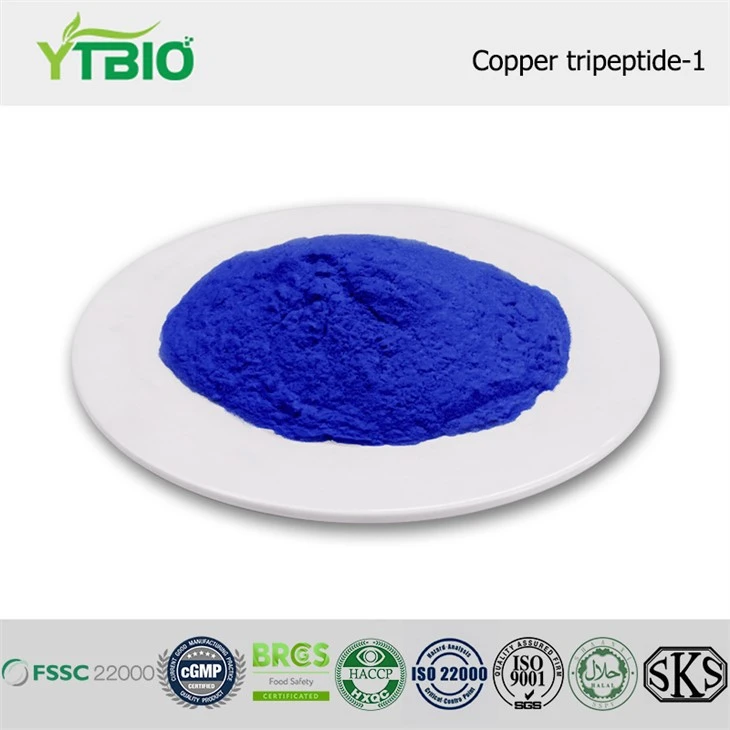
Shaanxi Yuantai Biological Technology Co., Ltd. is one of the most reliable manufacturers and suppliers of Copper Peptide Powder in China. With abundant experience, we warmly welcome you to wholesale bulk Copper Peptide Powder for sale here from our factory. Quality products and reasonable price are available.
About Our Copper Peptide Products
- High-Purity Raw Material Supply: We supply high-specification copper peptide active raw materials, with two core products, Copper tripeptide-1 and AHK-Cu, boasting a purity of up to 98%. This meets the research and formulation needs and large-scale production requirements of high-end cosmetics, ensuring higher utilization of raw material activity.
- Comprehensive Product Supply System: In addition to our core copper peptide series products, we simultaneously offer a wide range of functional skincare raw materials, covering various mainstream skincare active ingredients. This provides a one-stop solution for diverse customer procurement needs, reducing communication costs and procurement cycles associated with multiple parties, and adapting to different formulation development scenarios.
- Complete Quality and Compliance System: All raw materials possess complete qualification documents and testing certificates. Production processes adhere to standardized control regulations, and all indicators meet general compliance standards for cosmetic raw materials.
- Wide Application Compatibility: Both types of copper peptide components exhibit excellent biocompatibility and a clear skincare mechanism, possessing core values such as anti-oxidation, barrier repair, and active conditioning. They are suitable for use in various skincare products, including serums, creams, and repair products, demonstrating strong formulation compatibility.
Product Description
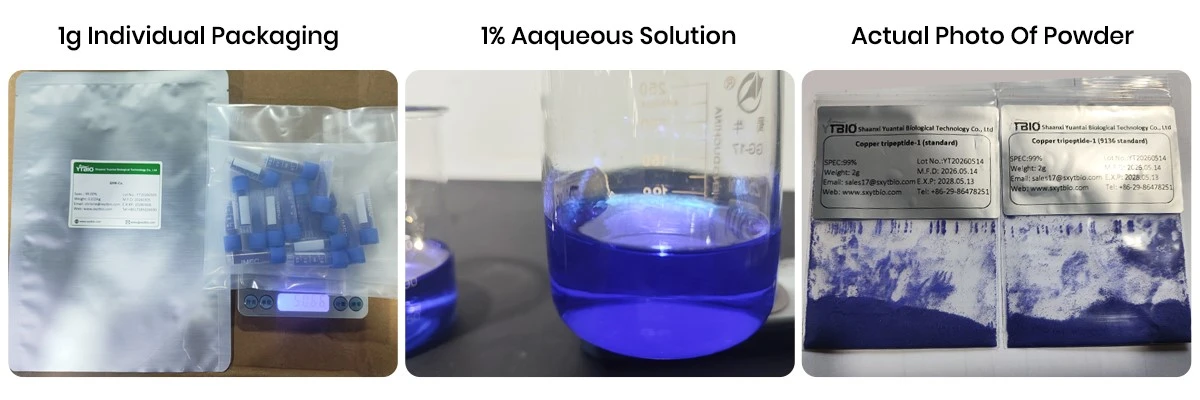
Copper Peptide Powder, also known as Copper tripeptide-1, is a complex of copper ions and tripeptide-1, in which the copper ions promote repair. Copper peptide is a compound composed of glycylhistidine tripeptide and copper. It is named for the blue color of its aqueous solution. It has gentle anti-wrinkle and firming effects and is one of the best anti-aging ingredients currently available. The overall efficacy of blue copper peptide is superior to tripeptide-1, thus attracting significant attention in the functional skincare market.
In 1973, Dr. Loren Picart isolated tripeptide-1 from human plasma proteins. This peptide, produced by the human body, is composed of glycine, histidine, and lysine. It primarily exhibits an effect on liver cell survival, which attracted the attention of the medical community. Further research revealed that tripeptide-1 has a strong chelating ability for metal ions, forming a stable blue complex with copper ions-blue copper peptide.
AHK-Cu is a synthetic or semi-synthetic copper peptide with the structure Ala-His-Lys-Cu, which focuses on promoting hair growth and preventing hair loss.

The differences between the two types
Different chemical structures:
AHK-Cu: A complex formed by alanine (Ala), histidine (His), and lysine (Lys) tripeptides and copper ions (Cu²⁺), with the molecular formula C₁₅H₂₄ClCuN₆O₄ and CAS number 682809-81-0.
Blue copper peptide: A complex formed by glycine (Gly), histidine (His), and lysine (Lys) tripeptides and copper ions, with the molecular formula C₁₄H₂₂CuN₆O₄ and CAS number 89030-95-5 or 49557-75-7 (depending on the ratio).
| Characteristics | AHK-Cu | Copper Tripeptide-1 |
| Amino acid sequence | Alanine - Histidine - Lysine | Glycine - Histidine - Lysine |
| Source | Artificially synthesized | Naturally present in the human body (in blood plasma) |
| Main advantages | Outstanding hair regrowth effect | Comprehensive anti-aging and repair |
| Focus on function | Stimulates hair follicles, promotes hair growth | Skin regeneration, wound healing |
| Applicable fields | Hair loss care, hair transplant repair | Anti-wrinkle, scar repair, holistic skin care |
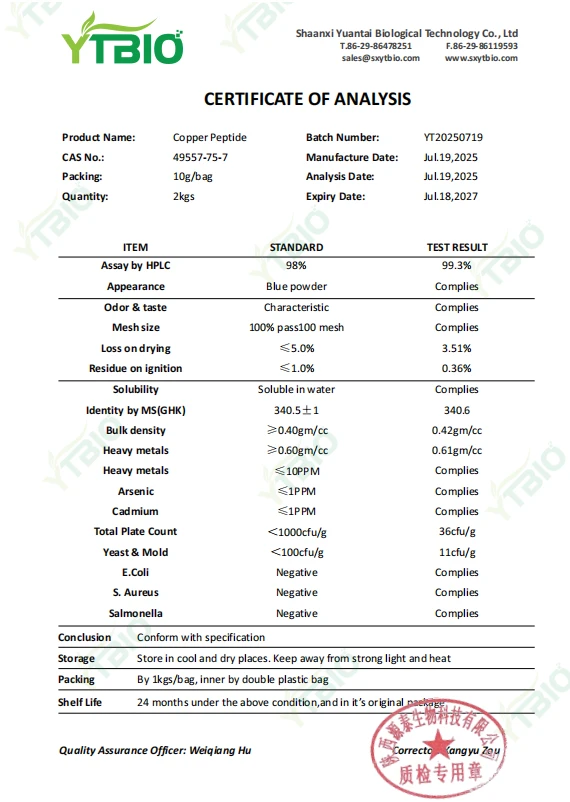
Test report
 |
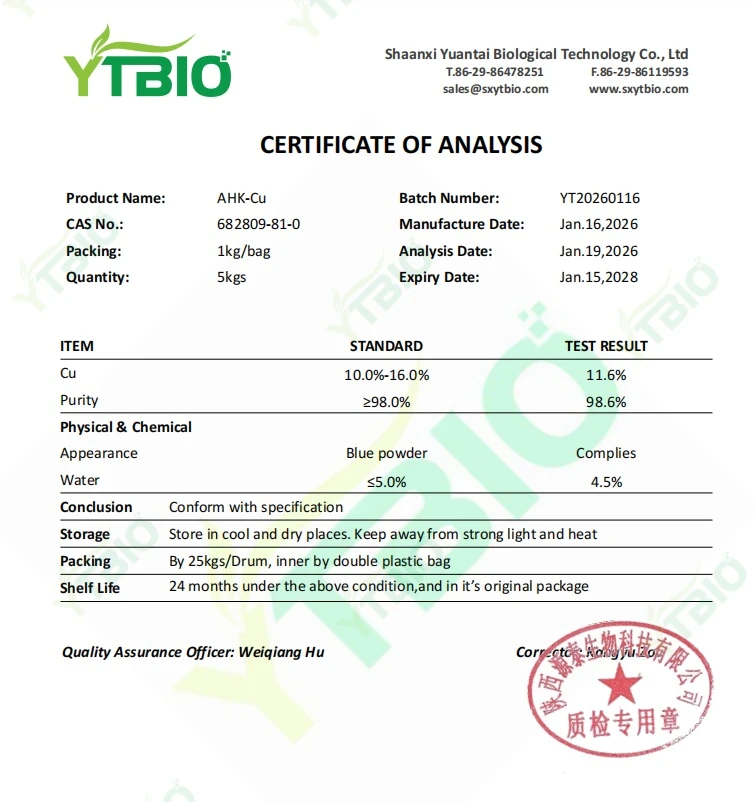 |
We can provide both of these products. Please contact sales@sxytbio.com for more information.
Product Details Table
| Product Name | Copper Peptide |
| CAS NO | 49557-75-7 |
| Formula | C14H24N6O4 |
| Molecular Weight | 340.38 |
| Flash Point | 456.4°C |
Molecular Structure
The molecular structure of Copper Peptide Powder has been studied in depth by methods such as X-ray crystallography, electron paramagnetic resonance spectroscopy, X-ray absorption broad spectrum, PMR spectroscopy and titration. In the Copper Peptide Powder complex, copper ions interact with the N atom replaced by the imidazole in the histidine side chain. The other N atoms come from the deprotonation between the α-amino group of glycine and the glycine-histidine peptide bond. amide nitrogen, as shown in the figure below
However, such a structure cannot well explain the high stability constant of the Copper tripeptide-1 complex (the stability constant of Copper tripeptide-1 is Log10=16.44, and the structure of it, which is similar to Copper tripeptide-1, has Log10=8.68). In recent studies, Hureau et al. found that Copper tripeptide-1 does not handle a copper ion alone. Copper tripeptide-1 firmly complexes copper ions through cooperation. That is, the oxygen atoms of the other two Copper tripeptide-1 lysines also participate in the complexation of copper ions. The oxygen on the carboxyl group of lysine in an adjacent complex is coordinated with copper ions, and the oxygen (carbonyl group) on the carboxyl group of lysine in another adjacent complex is also coordinated with the same copper ion, forming a pyramid structure. Its structure is shown in the figure below.
Studies have found that under physiological conditions, the Copper Peptide Powder complex can form a binary or ternary structure, which includes the Cu-binding region of histidine and human albumin. They were also found to readily acquire copper ions and bind to the copper transport site of human albumin. It has been proven that the redox properties of copper ions on Copper Peptide Powder are shielded, so that copper ions entering cells are safe for the cells.
Product Function
 1. Improve repair ability. Blue copper peptide can improve the self-repair ability of the skin. It can promote the synthesis of the skin matrix and strengthen the regeneration ability of cells.
2. Promote absorption. The molecular structure of blue copper peptide is very small, and most of them are small molecular proteins known as amino acids, which are easy to absorb. When added to cosmetics, it can promote the absorption of other components.
3. Deep awakening skin. When the blue copper peptide penetrates into the bottom of the skin, it can stimulate the vitality of cells, enhance the activity of the skin, make the skin moist and elastic, from inside and outside to send out a more shiny, moist feeling, so that the skin itself can also be enhanced to a certain extent.
4.The role of Copper Peptide on the skin is to moisturise, moisturise and whiten, because it can effectively lock 30 times the moisture, making the skin lastingly moisturised, shiny and delicate
5.Whitening effect can be achieved by inhibiting the production of melanin
6.It can repair the broken and aging elastic fiber network, restore skin elasticity, delay aging, and remove free radicals in the body
7.Copper Peptide can promote skin regeneration, increase the density of collagen and elastin, thereby rebuilding the skin's barrier, repairing some damaged skin, and extending the life cycle of cells, improving aging skin problems, and firming the skin.
8.Reduces skin scarring and promotes faster wound healing
Repair skin tissue and promote wound healing
Copper Peptide is a bioactive regulatory factor that naturally exists in the α2(I) chain of type I collagen in the extracellular matrix (ECM). It is released after skin injury and is an early signal for tissue repair. In addition, endothelial cells express a stromal cell-secreted glycoprotein, SPARC, which is degraded to produce Copper tripeptide-1, which is considered to be one of the sources of Copper tripeptide-1 in serum.
Copper ions are trace elements required for various enzymatic reactions in the human body. The content of divalent copper ions in human plasma is about 1 μg/mL, more than 95% of which is present in ceruloplasmin, and the remaining 5% is with other Molecules (such as albumin, histidine, etc.) bind. Due to its high affinity for copper ions, Copper tripeptide can antagonize other molecules, compete with them to complex copper ions, and serve as a carrier to deliver copper ions to the injury site to promote wound healing and tissue repair.
Epidermal stem cells exist in the basal layer and can differentiate into various cells in the skin when tissue is damaged, including fibroblasts, melanocytes, endothelial cells, etc. The loss of proliferation potential of epidermal stem cells is related to the reduction of integrin and p63 protein expression. Studies have found that Copper tripeptide-1 can significantly increase the expression of integrin and p63 protein, enhance the proliferation potential of epidermal stem cells, and enable them to better participate in tissue repair. process.
Reshape skin structure, resist aging and remove wrinkles
Copper Peptide Powder can effectively enhance the functionality of fibroblasts and stimulate them to synthesize glycosaminoglycans, proteoglycans, collagen, elastin and other ECM components, thereby reshaping the skin structure.
In addition, Copper Peptide can also promote the expression of matrix metalloproteinases MMP-2, MMP-9 and their tissue inhibitors TIMPs. By regulating the activity of MMPs and TIMPs, Copper Peptide can help maintain the balance between matrix decomposition and synthesis, accelerate tissue remodeling, and improve the appearance of skin aging.
Antioxidant and anti-inflammatory
Immune cells use reactive oxygen species and other powerful oxidants to fight bacteria, so oxidative damage always accompanies inflammation. Relevant studies have shown that Copper Peptide can inhibit inflammation by reducing the levels of acute inflammatory cytokines such as TGF-β and TNF-α. In addition, by providing copper ions to tissues, Copper Peptide Powder can increase the activity of superoxide dismutase, thereby inhibiting the generation of reactive oxygen species and achieving antioxidant effects.
Studies have shown that its ability to stimulate collagen synthesis is even stronger than that of powerful anti-aging ingredients such as retinoic acid or vitamin C. Compared with the latter VA and VC, it can also increase without harming or irritating the skin. The vitality of the cells gradually repairs the lost collagen in the body, making the subcutaneous tissue compact, thereby achieving the purpose of wrinkle removal and anti-aging.
Product Application
1.cosmetics: It can effectively promote the production of collagen and elastin, increase the vascular growth and antioxidant capacity, stimulate the production of glucosamine (GAGs), and help the skin recover the ability of self-repair. can increase the vitality of cells, gradually repair the lost collagen in the body, strengthen the subcutaneous tissue, and quickly heal the wound without harming the skin or stimulating the skin, so as to achieve the purpose of anti-wrinkle and anti-aging.

2.Shampoo:Expanding hair follicles accelerates hair growth and inhibits hair loss.
It stimulates the production of hair melanin, regulates the energy metabolism of hair follicle cells, removes skin free radicals, and inhibits the activity of 5-A reductase.
Blue copper peptide has many compatibility contraindications. In order to ensure that it can exert its due effect, you must avoid combining it with the following ingredients!
(1) Strong acids (including lactic acid, salicylic acid, fruit acid, mandelic acid, lactobionic acid, rhododendronic acid, malic acid, etc.)
Strong acidic substances easily react with blue copper peptide, making the color of blue copper peptide lighter and producing unknown objects, causing the blue copper peptide to lose its effect.
(2) VA alcohol and derivatives
When blue copper peptide meets VA alcohol, it will turn into a turbid and sticky green new object; VA alcohol will be converted into VA acid during the process of action. VA acid is highly acidic, and after reacting with blue copper peptide, it will Deactivation of copper ions leading to blue copper peptide.
(3) VC and derivatives
Copper is an oxidant, and VC is a reducing agent. When the two meet, they will produce a redox reaction, causing both to fail.
(4) Antioxidants such as carnosine and ergothioneine
The imidazole ring in the molecular structure of carnosine and ergothioneine can easily complex metal ions. When paired with blue copper peptide, it will compete for copper ions. The raw materials will interact with each other, causing both to fail and cause discoloration.
(5) Complexing agent (disodium EDTA, carbomer, etc.)
The complexing agent will rob copper ions and destroy the structure of blue copper peptide, causing it to lose activity and cause discoloration.
(6) Extracts with active enzymes (such as bifid yeast, plant extracts, etc.)
The components of the extract are unknown and relatively messy, and some unknown enzymes will decompose the copper peptide.
contact us
For more information about Copper tripeptide-1 or other products, please contact:
Email: sales@sxytbio.com
Tel/WhatsApp: +86 177 8257 7059
Hot Tags: Copper Peptide Powder, China Copper Peptide Powder manufacturers, suppliers, factory