
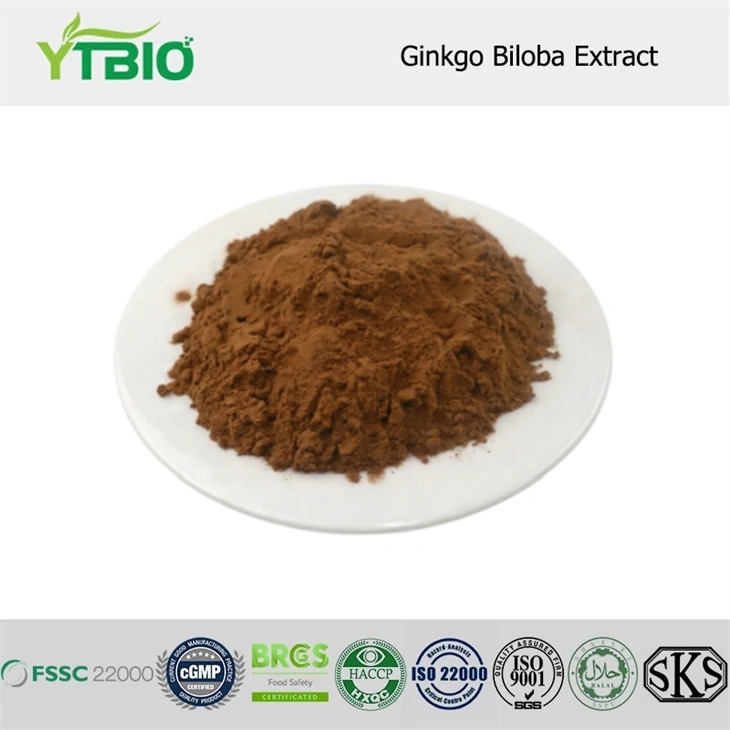
Shaanxi Yuantai Biological Technology Co., Ltd. is one of the most reliable manufacturers and suppliers of ginkgo biloba extract powder in China. With abundant experience, we warmly welcome you to wholesale bulk ginkgo biloba extract powder for sale here from our factory. Quality products and reasonable price are available.
What is Ginkgo Biloba Extract Powder?
Ginkgo Biloba Extract Powder (GBE) refers to the effective substances extracted from Ginkgo biloba, including total flavonoids of Ginkgo biloba, Ginkgolides and other substances. It has the functions of dilating blood vessels, protecting vascular endothelial tissue, regulating blood lipids, protecting low-density lipoprotein, inhibiting PAF (platelet activating factor), inhibiting thrombosis, and scavenging free radicals.

Main ingredients
Ginkgo biloba has a wide range of biological activities and contains a variety of chemical components, including flavonoids, terpenes, polysaccharides, phenols, organic acids, alkaloids, amino acids, steroid compounds, trace elements, etc. Among them, vitamin C, vitamin E, carotene, and mineral elements such as calcium, phosphorus, boron, and selenium are also very rich, but the most important medicinal value components are flavonoids and terpenes. Flavonoids and terpenes have many functions such as vasodilation and anti-oxidation.
Products Test report
|
Items |
Specifications |
Results |
Test Methods |
|
Appearance |
Fine powder |
Fine powder |
Visual |
|
Color |
Brownish yellow |
Brownish yellow |
Visual |
|
Odor |
Characteristic |
Characteristic |
Organoleptic |
|
Identification (Flavones) |
Identical to R.S. sample |
Complies |
TLC |
|
Identification (Lactones) |
Identical to R.S. sample |
Complies |
HPLC |
|
Total Ginkgo Flavones Glycoside |
22.0–27.0% |
24.91% |
HPLC (USP) |
|
Quercetin Glycoside |
- |
10.94% |
HPLC |
|
Kaempferol Glycoside |
- |
10.52% |
HPLC |
|
Isorhamnetin Glycoside |
- |
3.45% |
HPLC |
|
Total Terpene Lactones |
5.4–12.0% |
6.72% |
HPLC (USP) |
|
Ginkgolide A |
- |
1.94% |
HPLC |
|
Ginkgolide B |
- |
1.42% |
HPLC |
|
Ginkgolide C |
- |
0.67% |
HPLC |
|
Bilobalide |
2.6–5.8% |
2.69% |
HPLC (USP) |
|
Kaempferol/Quercetin |
≥0.7 |
Complies |
HPLC |
|
Isorhamnetin/Quercetin |
≥0.1 |
Complies |
HPLC |
|
Free Quercetin |
≤0.5% |
Complies |
HPLC |
|
Rutin |
≤4.0% |
Complies |
HPLC |
|
Ratio |
50:1 Approx. |
54:1 |
USP |
|
Ginkgolic Acid |
≤5 ppm |
2 ppm |
HPLC (USP) |
|
Loss on Drying |
≤5.0% |
3.7% |
USP <731> |
|
Residue on Ignition |
≤0.8% |
0.7% |
USP <731> |
|
Bulk Density |
0.40–0.60 g/ml |
0.52 g/ml |
USP <616> |
|
Tapped Density |
0.55–0.80 g/ml |
0.66 g/ml |
USP <616> |
|
Lead (Pb) |
≤1 ppm |
Complies |
USP <231> |
|
Arsenic (As) |
≤1 ppm |
Complies |
USP <231> |
|
Mercury (Hg) |
≤1 ppm |
Complies |
USP <231> |
|
Copper (Cu) |
≤1 ppm |
Complies |
USP <231> |
|
Residue of Solvents |
≤2000 ppm |
283 ppm |
USP <565> |
|
Pesticide Residues |
USP Requirements |
Meets USP Requirements |
USP <561> |
|
Total Plate Count |
≤10,000 CFU/g |
Complies |
USP <2021> |
|
Yeast & Mold |
≤1,000 CFU/g |
Complies |
USP <2021> |
|
E. Coli |
Negative |
Negative |
USP <2022> |
|
Salmonella |
Negative |
Negative |
USP <2022> |
|
Staphylococcus |
Negative |
Negative |
USP <2022> |
What are the benefits?
Skin care
Whitening: When the body is in poor condition, our endocrine system is easily disturbed and imbalanced. At this time, there are too many oxygen free radicals in the body, but the superoxide dismutase (SOD) is insufficient, resulting in excessive oxygen free radicals and dermal cells to produce oxidation reactions, forming a large amount of lipofuscin (lipid peroxide), causing chloasma or pregnancy spots. The flavonoids contained in ginkgo leaves can hinder the formation and deposition of pigments in the dermis, achieving the effect of whitening the skin and preventing and treating pigmented plaques. In addition to flavonoids, trace elements such as manganese and molybdenum in ginkgo leaves can also remove oxygen free radicals and inhibit the growth of melanin.
Wrinkle removal: It takes about 3 months for the human skin to be completely renewed, but why do we still have annoying fine lines on our faces? The reason is that the new cells formed in the dermis have been oxidized by too many free radicals before they reach the surface of the skin, and when they reach the epidermis, they are already aging cells. The flavonoids and flavonols in ginkgo leaves are both scavengers of free radicals. They can protect dermal cells, improve blood circulation, and prevent cells from being oxidized and causing wrinkles.
Ginkgo Leaf Flavonoids
Ginkgo leaf flavonoids are important active components of ginkgo leaves. Ginkgo leaf extract contains approximately 24% flavonoids, including quercetin glycosides, isorhamnetin, and kaempferol glycosides. Dopamine (DA) and acetylcholine (ACH), as important neurotransmitters in the brain, play a regulatory role in mood and cognitive function.
Studies have found that quercetin glycosides and kaempferol glycosides in ginkgo leaf extract can significantly increase the levels of dopamine and acetylcholine in the brain, thereby improving cognitive function.

Ginkgo Leaf Terpenoid Lactones
Ginkgo leaf terpenoid lactones are one of the main active components of ginkgo leaves, accounting for approximately 6% of the content in ginkgo leaf extract. They mainly include ginkgolides A, B, C, J, and diterpenoid lactones. Among them, ginkgolide B (GB) has been widely used to improve neurodegenerative diseases.
Multiple studies have confirmed that ginkgolide (GB) can cross the blood-brain barrier and act directly on the central nervous system, protecting neurons from β-amyloid-induced neurotoxicity, thereby alleviating Alzheimer's disease. Animal experiments have shown that long-term administration of GB to SAMP8 mice significantly improves their learning and memory abilities and delays cognitive decline.
Research has found that ginkgolide A can also alleviate cognitive impairment caused by Alzheimer's disease, exerting its neuroprotective mechanism by inhibiting CA1 neuron death and COX III mRNA expression.

Reference:
[1]Li Shao,Chen Dong,Deqin Geng,Qing He,Yu Shi. Ginkgolide B protects against cognitive impairment in senescence-accelerated P8 mice by mitigating oxidative stress, inflammation and ferroptosis [J] Biochemical and Biophysical Research Communications, 2021, Volume 572: 7-14.
[2]J. Kehr, S. Yoshitake, S. Ijiri, E. Koch, M. Nöldner4, T. Yoshitake. Ginkgo biloba leaf extract (EGb 761) and its specific acylated flavonol constituents increase dopamine and acetylcholine levels in the rat medial prefrontal cortex: possible implications for the cognitive enhancing properties of EGb 761 [J] International Psychogeriatrics (2012), Vol. 24, Supplement 1, S25–S34.
Product applications
Ginkgo biloba extract is one of the most widely used natural ingredients and is now widely used in pharmaceuticals, dietary supplements, functional foods, and other fields.
Food: Primarily used as a natural flavor enhancer and antioxidant co-ingredient.
Health Food: Primarily used as a supplement to regulate blood sugar, improve memory, and relieve fatigue.
Skincare Products: Possesses antioxidant and anti-inflammatory properties and is widely used in cosmetics and daily chemical products.
Pharmaceuticals: Primarily used for cardiovascular and nervous system-related circulatory disorders.

contact us
YTBIO mainly supplies Ginkgo Biloba Extract Powder etc. The company was established in 2014 and has many years of R&D and production experience. We are committed to the research and development, production and sales of raw materials for the 21st century health industry. The certificates obtained so far include ISO9001, ISO22000, HALAL, KOSHER, HACCP, FDA,etc. We always maintain the highest requirements for product quality.
Contact us now for samples, technical information, and customized quotes.
Telephone/WhatsApp:+8617782577059
Email:sales@sxytbio.com
Hot Tags: ginkgo biloba extract powder, China ginkgo biloba extract powder manufacturers, suppliers, factory