Shaanxi Yuantai Biological Technology Co., Ltd. is one of the most reliable manufacturers and suppliers of sponge spicule powder in China. With abundant experience, we warmly welcome you to wholesale bulk sponge spicule powder for sale here from our factory. Quality products and reasonable price are available.
Product Introduction
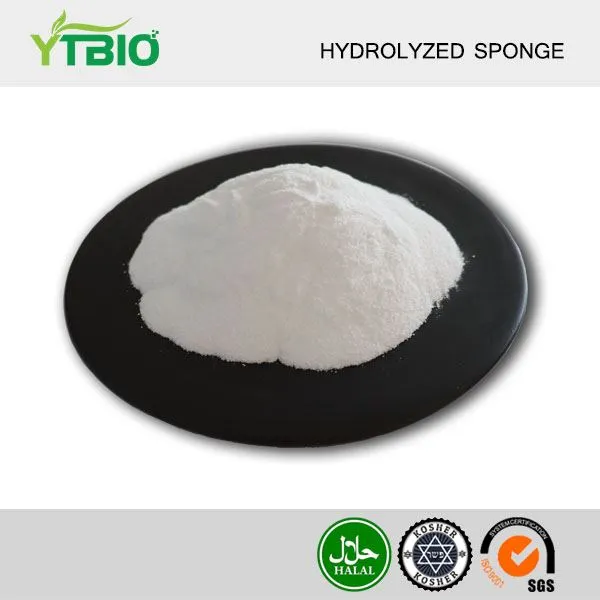
 Hydrolyzed Sponge are biological needles naturally evolved to adapt to the living environment. They are very tiny and powdery. The essence is an
extremely tiny needle-like bone. The needle tip can penetrate the pores, so it is also called sponge spicule. It can directly open the skin channel directly to the dermis, help activate skin microcirculation, relieve clogged pores, accelerate skin metabolism and exfoliation of aging stratum corneum, and shorten the skin's renewal cycle from 28 to 1 week.
Hydrolyzed Sponge are also called sponge spicules(spicule sponge) powder,spongilla spicules,diatom spicules, water needles, biological microneedles, etc. Sponge is one of the simplest multicellular organisms that grows in the ocean or freshwater environment. It is powdery to the naked eye, and it is a sharp rod-shaped crystal spicule and a blunt spicule under a microscope. This needle-like crystal is a very good adsorbent for impurities. It can not only destroy the protein structure of microorganisms or viruses, but also the negative ion charge it carries can also adsorb impurities or precipitate pigments in the solution.
Sponge Spicule Manufacturer
Professional Sponge Spicule(sponge extract) supplier, currently can supply 70%, 95%, 99% and other high-standard products, and supports third-party testing, as a high-quality sponge spicule powder supplier, we have an absolute price advantage for this product
We have all the products on sale in stock, which can guarantee the timeliness of delivery, and we have set up overseas warehouses. For some products, we support direct shipment from overseas warehouses. For details, please contact us
The products supplied by YTBIO are all raw materials, which are mainly added to food, health products, cosmetics, etc., and cannot be used directly
Why Choose Us:
1. Has 12 years of production and sales experience in the plant extract industry.
2. International certification system: ISO9001, ISO22000, Kosher, Halal, HACCP, FDA organic and other certifications.
3. Professional and experienced R&D and sales team
4. Complete product categories: plant extracts, nutritional supplements, cosmetic raw materials, organic products, etc.
Hydrolyzed sponge under the microscope:

Product Benefits
Compared with the roller microneedle, this needle is more and smaller and can cover more pores. At the same time, due to the special physical properties, it is not limited to equipment. Powder or gel microneedle raw materials can be added to any kind of cosmetics, such as powder, cream, essence, gel, water, etc. The operation is simple, and the use is not limited to beauty salon lines or dermatology. Bone acupuncture powder with a purity of up to 98% can be used as a single ingredient to be added to any cosmetics. Its effect of dredging pores and accelerating metabolism makes the hydrolyzed sponge a raw material with a wide range of applications and low side effects. Adopted by the person.
The reason why sponge microneedles can improve skin problems quickly and efficiently is that they use the tiny needles on the microneedles to stimulate the skin. In a short time, the microneedles can make more than millions of microscopic channels, so that the active ingredients can effectively penetrate the skin and stimulate When new cells are regenerated, the microneedle nutrition is fully transformed into cell active substances. So as to achieve the ideal effects of reducing wrinkles, whitening skin, reducing spots, improving eye wrinkles, dark circles, tightening and lifting facial skin tissues. At the same time, the microneedles stimulate the dermis and promote collagen proliferation through the skin's self-healing ability.

Comparison of hydrolyzed sponge and microneedle:
|
Name |
Hydrolyzed Sponge Peeling |
Microneedle Peeling |
|
Principle |
Broken skin into essence, stimulate collagen regeneration, accelerate skin metabolism |
Broken skin into essence, stimulate collagen regeneration, accelerate skin metabolism |
|
Aching feeling |
General |
Very painful |
|
Risk |
Zero risk |
Easy to get infected |
|
Side effect |
No side effects |
Pigmentation, leaving scars |
|
Whether bleeding |
No |
Bleeding |
|
For people |
Anyone |
Metal allergy, scar body can not be used |
|
Raw materials |
Silica crystals extracted from deep sea sponge organisms |
Titanium alloy |
|
Solve skin problems |
Dark yellow skin, anti-black after laser surgery, blackheads, enlarged pores, pimples, pustules, oil control, folliculitis, skin pigmentation, fine wrinkles (Chloasma, lead mercury spots, rebound spots can be diminished) |
Dark yellow skin, anti-black after laser surgery, blackheads, enlarged pores, pimples, pustules, oil control, folliculitis, skin pigmentation, fine wrinkles (Chloasma, lead mercury spots, rebound spots can be diminished) |
Test Report

Please feel free to contact us for more specifications!
Product Application
Powdered or gelatinous microneedle ingredients can be added to any type of cosmetic such as pulvis , cream, essence, gel, water, etc.
It can remove wrinkle, skin whitening and lighten spots.

Working principle

Mechanism Of Action Of Hydrolyzed Sponge:
·Fine needle penetrating sponge (20-200um)
·Go deep into the cuticle, the epidermis
·Promote epidermal microcirculation
·Activate new skin activity
Effect of sponge microneedle technique:
Improve skin microcirculation
Accelerate skin metabolism
Shorten skin activity
Shorten the 28-day skin metabolic cycle miracle to 72 hours
Effective improvement skin
> Skin color dark yellow, pigment bleak
> Pore is thick, blackhead acne
> Delicious wrinkles, red blood ....
Sponge micro-needle rejuvenation technology market application
> Acne item products
> Freckle Project Products
> Anti-aging products
> Hormone Repair Project Products
Flow Chart-Hydrolyzed Sponge

For more information about Sponge Spicule Powder or other products, please contact:
Email: sales@sxytbio.com
Tel/WhatsApp: +86 177 8257 7059
Test Method
Unless otherwise stated, only reagents confirmed to be of analytical grade and distilled or deionized water or water of equivalent purity were used in the analysis. The solution required in the determination is an aqueous solution unless otherwise specified, and its concentration is expressed in mass fraction.
1.1 Sensory requirements
Sensory determination of the appearance and smell of the samples.
1.2 pH
1.2.1 Instruments and Reagents
1.2.1.1 pH meter: Accuracy 0.1.
1.2.1.2 Phosphate standard buffer solution (pH 6.86, 25℃): Accurately weigh 3.55g of anhydrous disodium hydrogen phosphate and 3.40g of potassium dihydrogen phosphate dried at 115℃±5℃ for 2~3 hours, add water to make the solution Dissolve and dilute to 1000 mL.
1.2.1.3 Borax standard buffer solution (pH9.18, 25℃): Precisely weigh 3.81g of borax (be careful to avoid weathering), add water to dissolve and dilute to 1000mL.
1.2.2 Analysis steps
1.2.2.1 Calibrating the pH Meter with Phosphate Standard Buffer and Borax Standard Buffer
1.2.2.2 Place the hydrolyzed sponge in water in the ratio of hydrolyzed sponge: water (1:99), stir for 5 minutes, filter, and measure the pH of the filtrate at 25°C with a pH meter.
1.3 Microscopic identification
1.3.1 Instruments and Reagents
1.3.1.1
microscope
1.3.1.2
Glycerin for tableting: take 25mL of glycerol, add 50mL of water, and mix well.
1.3.1.3
Chromic acid digestion solution: take 80 g of potassium dichromate, dissolve it in 50 mL of water by heating, slowly add 100 mL of concentrated sulfuric acid, stir continuously with a glass rod, and after the solution is completely cooled, centrifuge (5000 rpm for 5 minutes) to collect the upper dark brown Chromic acid digestive juice.
1.3.2 Analysis steps
1.3.2.1
Take a little powder of this product, put it on a dry glass slide, add dropwise glycerol for tableting, and observe it with a microscope.
1.3.2.2
Take 0.1~0.3g of the sample, put it in a 1.5mL plastic centrifuge tube, add 0.2~0.5mL chromic acid digestion solution, cover tightly, and place it in a water bath at 50~70°C for 2~5 minutes, during which time it is turned continuously. Take out the centrifuge tube, add water, mix well, and centrifuge (8000 rpm for 5 minutes) to collect bone spicules. Repeat twice to remove chromic acid solution and digestion products. Add 0.5 mL of water to the spicule precipitation, oscillate to suspend the spicule, immediately draw the suspension onto a clean glass slide, and after the sample is dry, add dropwise glycerol for tableting, and observe with a microscope.
1.4 Moisture
According to GB/T6284 General method for the determination of moisture in chemical products - Determination on drying method.
1.5 Lead
Determined according to the Safety Technical Specification for Cosmetics (2015 Edition).
1.6 Arsenic
Determined according to the Safety Technical Specification for Cosmetics (2015 Edition).
1.7 Mercury
Determined according to the Safety Technical Specification for Cosmetics (2015 Edition).
1.8 Cadmium
Determined according to the Safety Technical Specification for Cosmetics (2015 Edition).
1.9 Asbestos
Determined according to the Safety Technical Specification for Cosmetics (2015 Edition).
1.10 Biosilicon
Determined according to Appendix A.
Determination of biosilicon content by gelatin coagulation gravimetric method
A.1 Principle
This product bio-silicon refers to biogenic silica derived from sponge bone spicules. The sample is decomposed by alkali melting, acidified with hydrochloric acid, evaporated to dryness, added with hydrochloric acid, coagulated with gelatin, filtered, precipitated, burned and weighed to obtain the content of silicon dioxide (bio-silicon).
A.2 Reagents
Unless otherwise stated, only reagents confirmed to be of analytical grade and distilled or deionized water or water of equivalent purity were used in the analysis. A.2.1 Ethanol
A.2.2 Potassium hydroxide
A.2.3 Hydrochloric acid
A.2.4 Gelatin
A.3 Instruments
A.3.1 Nickel crucible: 50mL
A.3.2 High temperature furnace: controllable temperature 950℃±50℃
A.4 Analysis steps
Take 1.0g of the sample (accurate to 0.000lg) and put it in a nickel crucible, wet it with a few drops of ethanol, add 5g of potassium hydroxide, heat it on a low-temperature electric furnace to remove moisture, put it into a high-temperature furnace to melt for 30 minutes, and take it out to cool. Put the nickel crucible into a 250mL beaker, add 50mL boiling water, soak the melt, and then wash the crucible with a small amount of dilute hydrochloric acid and hot water. Immediately add 25mL of hydrochloric acid, put it on a water bath and evaporate to near dryness, then add 25mL of hydrochloric acid, heat on the water bath for 10 minutes, add 10mL of gelatin solution (10g/L), stir, keep it on the water bath for 10 minutes, add 40mL of dilute hydrochloric acid, stir dissolve salts. Filter through quantitative filter paper, wash the beaker and precipitate thoroughly with dilute hydrochloric acid. The filter paper and the precipitate are put into a porcelain crucible of known mass, ashed at low temperature, and fired at 950℃±50℃ to constant mass.
A.5 Result calculation
The content of bio-silicon is calculated in terms of the mass fraction w1 of silicon dioxide (SiO2), and the value is expressed in %, calculated according to formula (A.1)
w1= *100% ……………………………………… (A.1)
formula:
m1-the mass value of the sample residue and the porcelain crucible, in grams (g);
m2----the mass value of the porcelain crucible, in grams (g);
m0----the mass value of the sample, in grams (g);
The arithmetic mean of the parallel determination results is taken as the determination result, and the absolute difference between the two parallel determination results is not more than 0.2%.
Hot Tags: Sponge Spicule Powder, China Sponge Spicule Powder manufacturers, suppliers, factory