Shaanxi Yuantai Biological Technology Co., Ltd. is one of the most reliable manufacturers and suppliers of retinol manufacturer in China. With abundant experience, we warmly welcome you to wholesale bulk retinol manufacturer for sale here from our factory. Quality products and reasonable price are available.
What is retinol?
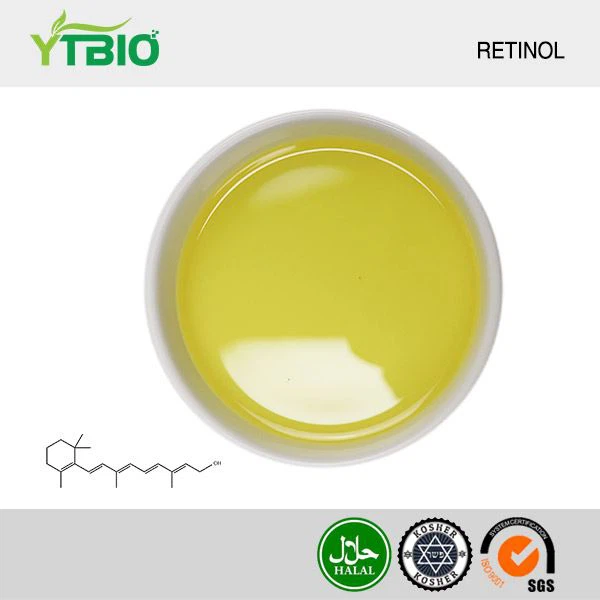
Retinol, also known as all-trans-Retinol, is a member of the vitamin A family. In the skin care industry, retinol has been given the reputation of "all-rounder of skin care". This is mainly because of its powerful functions. Ordinary skin care ingredients are more targeted. Usually, there is only one effect on the skin, and few have more than three effects on the skin like retinol.
Retinol is one of the most effective active molecules in cosmetic anti-aging formulations and is respected by skin care experts and consumers around the world. It is widely used to improve a series of skin problems such as pores, fine lines, wrinkles, spots, and dullness. It has also been used to care for acne-prone skin. It has the reputation of "skin care all-rounder" and "anti-aging gold standard" , in recent years, there has even been a skin care trend of "C in the morning and A in the evening".
Retinol, or vitamin A, is a fat-soluble vitamin that can only be absorbed through exogenous sources and is necessary for the human body. The human diet contains two main sources of vitamin A: meat and vegetables. After vitamin A enters the body, part of it is utilized and metabolized, and the other part is stored in various organs, mainly the liver.
Common retinol and its derivatives in the human body include: retinol (A alcohol), retinal (A aldehyde), retinoic acid (retinoic acid, A acid) and retinyl ester (A ester). The above are collectively called the retinoid family, which have similar chemical structures and biological activities and can be transformed into each other.

Retinol Supplier
As a retinol manufacturer,We have two specifications for retinol, 50% and 99%, 50% is in liquid form and needs to be stored below 0 degrees Celsius, 99% is in powder form and needs to be stored below -20 degrees Celsius, and 99% is Custom specifications. We have sold a lot of this product including some well-known brands. We use cold chain transportation to ensure the stability of the product during transportation. For more detailed information about this product, please contact us. We will have a professional on this The staff will give you detailed answers
Product Details Form
| Product Name | Active Ingredient | Specification | Form | Storage Condition | Test Method | Application |
|---|---|---|---|---|---|---|
| Retinol Liposome | Retinol | 10% | Liquid | Store below 0℃ long term | HPLC | Cosmetic Raw Material |
| Retinol Liposome | Retinol | 50% | Liquid | Store below 0℃ long term | HPLC | Cosmetic Ingredient |
| Retinol Solution | Retinol | 50% | Liquid | Store below 0℃ long term | HPLC | Cosmetic Raw Material |
| Retinol Powder | Retinol | 99% | Powder | Store at -20℃ long term | HPLC | Cosmetic Ingredient Research Use |
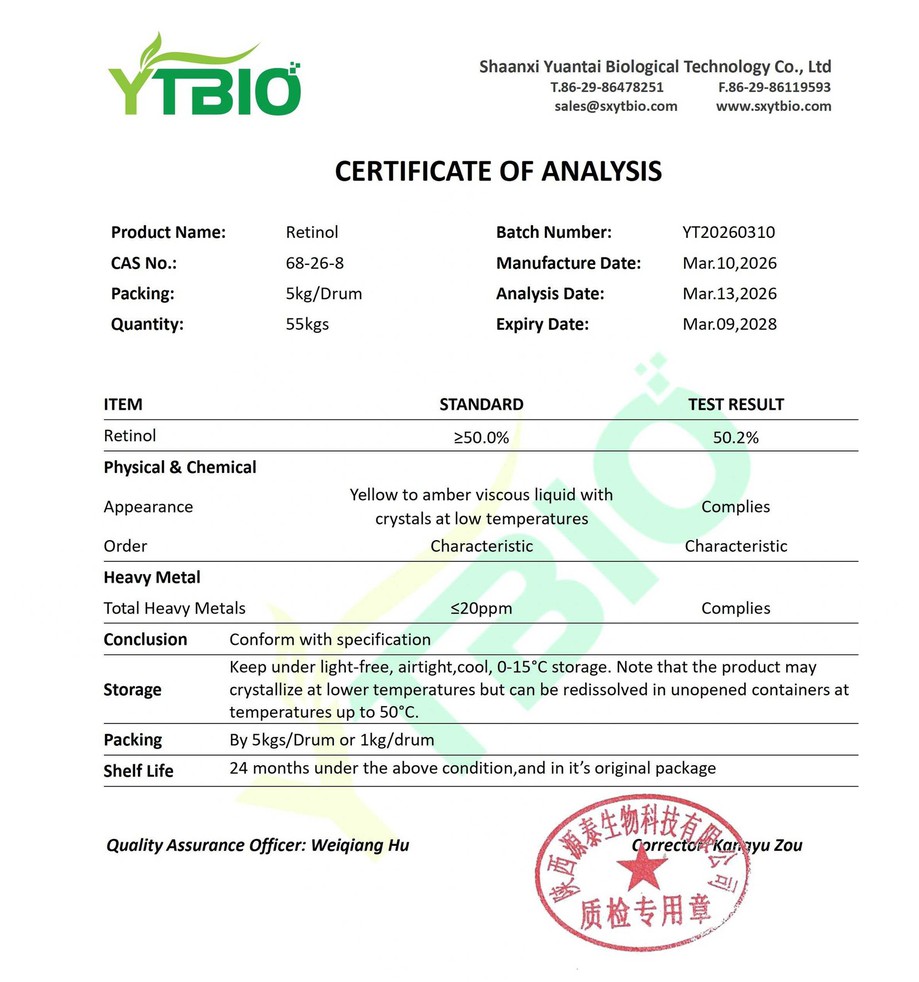
Test Report
What are the benefits for the skin?
The main effect of retinol on the skin is to help the stratum corneum of the skin restore normal metabolism, thicken the stratum corneum of the skin, and enhance the water storage capacity of the skin; in addition, it can also promote the production of collagen in the dermis of the skin.
1. Refine pores
Retinol can promote the normal differentiation of skin keratinocytes, so it can make the distribution of keratinocytes more compact, so using retinol skin care products, the pores will become more delicate and the skin will become firmer and smoother.
2. Anti-aging and anti-wrinkle
On the one hand, retinol can prevent the decomposition of dermal collagen and reduce wrinkles; on the other hand, it can promote the synthesis of dermal collagen to improve and lighten wrinkles.
3. Acne
Relevant studies have shown that retinol has an anti-inflammatory effect on the skin, which can inhibit the secretion of sebum in the hair follicles, improve the accumulation of keratin in the pores, and prevent the pores from being blocked, so the acne-removing effect is obvious.
4. Whitening
Retinol can accelerate the metabolism of keratinocytes and inhibit the production of melanin, so when used together with skin care products containing whitening ingredients, the effect will be even higher.
5.Retinol's target
In the skin, retinol is naturally present in the epidermis and increases in concentration from the stratum corneum to the basal layer. Retinyl ester is the storage form of retinol in keratinocytes, which can be converted into retinol and further into retinoic acid when needed to maintain dynamic balance. Its biological targets have been fully studied at the molecular level, mainly through binding to specific nuclear receptors to initiate specific gene regulation.

Since retinol itself cannot directly bind to nuclear receptors, the currently widely accepted theory is that retinol needs to undergo a series of oxidation reactions in cells to convert it into retinoic acid before it can further exert its effects. After retinol enters cells, it will widely increase the expression of alcohol dehydrogenase (ADH) and be oxidized into retinal, which can more selectively bind to retinal dehydrogenase (RALDH) to thereby Oxidized to retinoic acid. Retinol exists in different isomeric forms: trans-retinol and cis-retinol. Only trans-retinol (which makes up the majority in most tissues) is the active form that is converted into retinoic acid.
In what fields is it applied?
Due to its key physiological functions and multi-target mechanism of action, the retinoid family is widely used in the fields of medicine and cosmetics. In most countries and regions, retinoic acid is an ingredient in prescription drugs, while retinol, retinaldehyde and retinyl esters are ingredients in over-the-counter drugs, medical skin care products and cosmetics.
Medical field: Topical or oral treatment of a variety of local or systemic diseases, including dietary supplementation to treat vitamin A deficiency or malabsorption, promote corneal healing, treat abnormal keratosis (psoriasis, ichthyosis, etc.), improve acne and photoaging wait.
Cosmetics field: Retinol is an anti-aging ingredient that can be added to cosmetics. Its application can be traced back to the early 20th century. Since the 1990s, major cosmetics groups have invested a lot of research and development efforts to develop retinoids that meet cosmetic specifications. Ingredients, protect their patents, and make full use of professional knowledge and experience to optimize the formula in terms of active ingredient synergy and formula stability. Today, retinoid ingredients used as anti-aging ingredients in cosmetics mainly include retinol, retinyl acetate, retinyl palmitate and retinaldehyde. The first three have been approved by the European Scientific Committee on Consumer Safety (SCCS). ) recognized as safe ingredients; the latest applications also include: hydroxypinacolone retinoate (HPR), retinoid ingredient compatibility, plant-derived retinoid substitutes, etc.

Applying proteomic methods to study the skin action mechanism of retinol
Proteomics is a method for comprehensive identification of all protein content in an organ, tissue or cell line at a specific time point and under conditions. Compared with genomics and transcriptomics, it can more directly reflect changes in functional proteins and correlate with phenotypes. It may be more directly related. At the same time, it can provide an overall understanding of all biological functions carried by proteins and help establish important biological markers.
Through proteomic research, L'Oréal scientists obtained 220 proteins related to retinol and 227 proteins related to retinoic acid, of which 164 proteins were highly overlapping, and the regulation patterns (up-regulation or down-regulation) were highly consistent (Figure 4). The functional classification of these proteins can be classified into six major categories: energy metabolism, protein synthesis, glycolysis, wound healing, defense and skin barrier function, of which the first three are new discoveries. The analysis believes that increasing energy metabolism and energy supply, accompanied by an increase in protein synthesis, is consistent with the clinical effect of retinol on increasing epidermal thickness and improving skin quality.
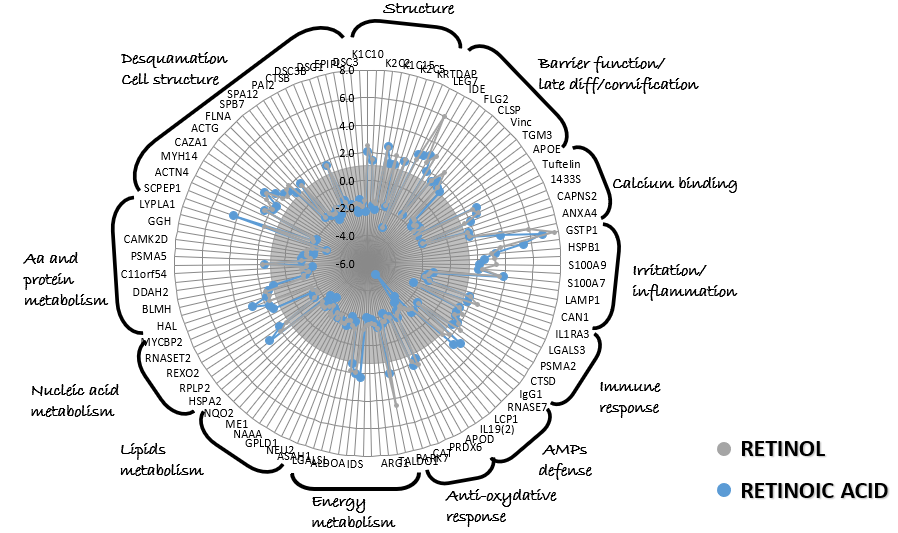
Proteomics shows that retinol (gray) and retinoic acid (blue) have highly overlapping and highly consistent protein regulation
Using multiphoton microscopy imaging technology to observe the skin effects of retinol
Multiphoton microscopy imaging technology can avoid invasive biopsies and observe the structure of skin tissue. It can not only perform plain scans, but also obtain clear and sharp longitudinal sections, and even observe three-dimensional solid structures through modeling. Utilizes endogenous multi-photon signals to display characteristic molecular and structural information of the epidermis and superficial dermis with resolutions up to sub-micron level. With 3D image processing tools, different layers of skin can be automatically layered and their quantitative parameters extracted and analyzed. Multiphoton microscopy imaging technology can well reveal the characteristics of skin pigmentation, skin aging or photoaging, skin diseases such as melanoma, and can also be used to evaluate the skin permeability and efficacy of drugs and cosmetics.
Using multiphoton microscopy imaging technology, scientists observed the skin effects of topical use of 0.3% retinol and 0.025% Vitamin A acid for more than one year. The results showed that after one year of using retinol, the epidermal thickness increased significantly by up to 30%, the undulation of the dermal-epidermal junction also increased slightly but not significantly, and the density and longitudinal distribution of epidermal melanin were also significantly improved. The latter may be used as a It is an early sensitive indicator of photoaging. In addition, the cosmetic formula 0.3% retinol has similar or even more significant effects than the topical drug formula 0.025% retinoic acid.

Multiphoton microscopy imaging shows changes in epidermal thickness before and after one year of topical application of a 0.3% retinol formula (epidermis: blue; dermis: red)
Benefit
Retinol is currently the most widely used and well-known star player. It also has a good effect. Vitamin A alcohol is a fat-soluble component, which can penetrate the stratum corneum and reach the dermis.
The effective concentration of retinol is about 0.1%. Experimental results also showed that 0.1% retinol had a significant improvement in fine lines and wrinkles, hyperpigmentation, elasticity, firmness and overall photodamage after eight weeks of use
The concentration reached 0.4%, even in a self-controlled test on the inner upper arm of an average age of 87, after 24 weeks of continuous use. It can also significantly reduce the wrinkles that have already formed, which is also the optimal concentration of retinol. No matter how high the concentration is, the irritation will increase significantly, and the effect will not be good.

For more information about Retinol or other products, please contact:
Email: sales@sxytbio.com
Tel/WhatsApp: +86 177 8257 7059
Hot Tags: retinol manufacturer, China retinol manufacturer manufacturers, suppliers, factory