Shaanxi Yuantai Biological Technology Co., Ltd. is one of the most reliable manufacturers and suppliers of dl-mandelic acid in China. With abundant experience, we warmly welcome you to wholesale bulk dl-mandelic acid for sale here from our factory. Quality products and reasonable price are available.
What is DL-mandelic acid?
Mandelic acid Powder, alias: 2-hydroxy-2-phenylacetic acid, α-hydroxyphenylacetic acid, phenylglycolic acid. In cosmetics and skin care products, the main functions are whitening and freckle removal, exfoliation, and antibacterial agents. The risk factor is 1. It is relatively safe and can be used with confidence. It generally has no effect on pregnant women, and mandelic acid does not cause acne.
DL-mandelic acid (first extracted from bitter almonds) is a large molecular weight fruit acid, which can accelerate the metabolism of skin cells, and has a certain antibacterial ability and whitening effect.
DL-mandelic acid, also known as mandelic acid and phenyl glycolic acid, was first extracted from peach leaves and willow leaves, and has the same source as salicylic acid. Mandelic acid is a lipophilic acid with high affinity to the skin, strong permeability, and is more gentle than glycolic acid. Because its chemical structure is similar to antibiotics, it can inhibit the proliferation of a variety of bacteria. Its good lipophilicity and antibacterial properties enable mandelic acid to inhibit Propionibacterium acnes and improve the obstruction of pilosebaceous gland ducts. It also has obvious effects on improving photoaging and post-inflammatory pigmentation. Salicylic acid-almond has been used clinically. Acid-related treatments for skin peels.
Test Report

What are the benefits for the skin?
Exfoliating: Mandelic acid has an exfoliating effect, which helps reduce fine lines.
Whitening: remove melanin deposited in stratum corneum cells, improve pigmentation, and have whitening effects (can be used to lighten acne marks).
Suitable for sensitive skin: Mandelic acid is less irritating to the skin, and it is also suitable for sensitive skin.
Bacteriostasis: Mandelic acid can inhibit the activity of Staphylococcus epidermidis, Candida albicans and other bacteria and act as an antibacterial agent.
Benefits for acne-prone skin: Its antibacterial and anti-inflammatory properties make it an effective acne-fighting ingredient. Regulates sebum production and reduces blemishes
Reduces fine lines and wrinkles: Softens fine lines and prevents the appearance of wrinkles by stimulating collagen and elastin production.
Relieves Large Pores: Due to its exfoliating action, it unclogs and reduces the appearance of large pores.
Folliculitis: Fungal infections of the hair follicles are also easily cleared with mandelic acid.
Mechanism
Mandelic acid has antibacterial properties because its chemical structure is similar to antibiotics. Mandelic acid at a concentration of 2.5% can kill 1 million E. coli in 1 minute; 1 million Staphylococcus aureus in 4 minutes; and 1 million Staphylococcus aureus in 0.5 minutes. It can kill 100,000 Staphylococcus epidermidis and about 800 Candida albicans in 16 minutes.
Since there are chiral carbon atoms in the molecular structure of mandelic acid, it is not only an important chiral drug intermediate and fine chemical product, but also a synthetic vasodilator-cyclomandelate, urinary tract infection anti-inflammatory drug - antispasmodic drug - benzyl mandelate and other drugs.
Inhibitory mechanism of mandelic acid on the activity of sortase A of Staphylococcus aureus
Test method: The two-fold broth dilution method and plate coating method were used to study the in vitro inhibitory effect of mandelic acid on Staphylococcus aureus; the growth curve of Staphylococcus aureus in culture media containing different mass concentrations of mandelic acid was measured.

Results: Within the test mass concentration range (0, 64, 128, 256, 512 and 1024 μg/mL), it had basically no effect on Staphylococcus aureus and its growth.

Results: Mandelic acid can compactly bind and interact with the active center of SrtA (Staphylococcus aureus sortase A) to form a stable complex, ultimately inhibiting the biological activity of SrtA and having the potential to become an inhibitor against Staphylococcus aureus infection. .
Application direction
DL-Mandelic acid is widely used in cosmetics
Mandelic acid is suitable for dry skin, firm skin, non-pigmented skin, wrinkled skin, tolerant skin, pigmented skin, oily skin, these 7 types of skin.

Composition Analysis
Accelerates the metabolism of skin cells, has an exfoliating effect, helps reduce fine lines, and at the same time removes melanin deposited in stratum corneum cells, improves pigmentation, and has a whitening effect (can be used to lighten acne marks). However, the effect is slightly inferior to that of glycolic acid, because mandelic acid has a large molecular weight and weak permeability. Because of this, mandelic acid is less irritating to the skin and is also suitable for sensitive skin. In addition, mandelic acid can inhibit the activity of Staphylococcus epidermidis, Candida albicans and other bacteria, as an antibacterial agent. It should be noted that mandelic acid is photosensitizing and is recommended for evening care.
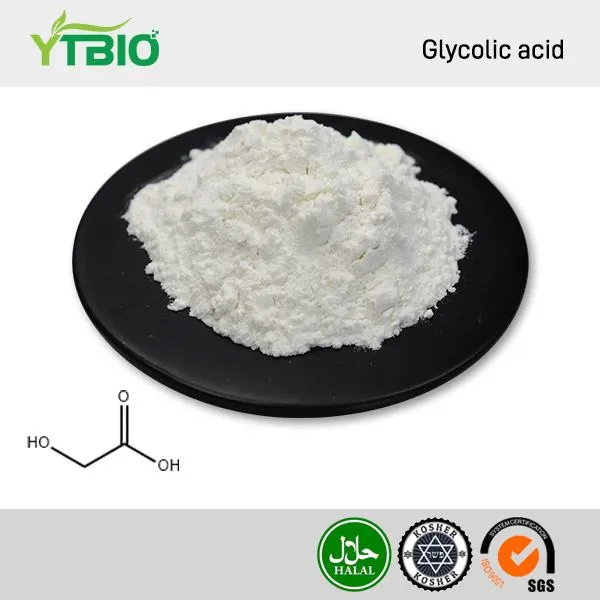
A fruit acid belonging to an alpha hydroxy acid with lipophilic properties. Compared with the common fruit acid-glycolic acid, mandelic acid has certain antibacterial ability. At the same time, compared with common glycolic acid and lactic acid, mandelic acid may have a slower penetration rate, which means that the irritation is less than that of glycolic acid. Its fat solubility is increased, and the ability of the stratum corneum to penetrate the skin is improved. Therefore, glycolic acid also has the function of dredging the oil in the pores and removing acne. Like glycolic acid and lactic acid, mandelic acid also has a certain whitening effect.
Products Description
| Melting point | 119-121 °C (lit.) |
| Specific rotation | [α]D20 -0.5~+0.5° (c=2, H2O) |
| Boiling point | 214.6°C (roughestimate) |
| Density | 1.30 |
| Vapor pressure | 0.01Pa (50°C) |
| Refractive index | 1.4810 (estimate) |
| Solubility | Soluble in water (181 mg/ml at 25° C), ether, ethanol, methanol, and chloroform. |
| Acidity coefficient | (pKa) 3.85 (at2Chemicalbook5℃) |
| PH value | 2.3 (10g/l, H2O) |
| Optical activity | (opticalactivity)[α]/D0±1°,c=5inH2O |
| Water solubility | 150g/L (20ºC) |
| Vapor pressure | <0.1 hPa (25 °C) |
| Bulk density | 750 kg/m3 |
| TYPE OF INGREDIENT | Exfoliator |
| MAIN BENEFITS | Increase in cell turnover, anti-acne, anti-aging. |
| DON'T USE WITH | Other AHAs, other peels, retinol, retinoids. |
For more information about DL-mandelic Acid or other products, please contact:
Email: sales@sxytbio.com
Tel/WhatsApp: +86 177 8257 7059
Hot Tags: DL-Mandelic Acid, China DL-Mandelic Acid manufacturers, suppliers, factory